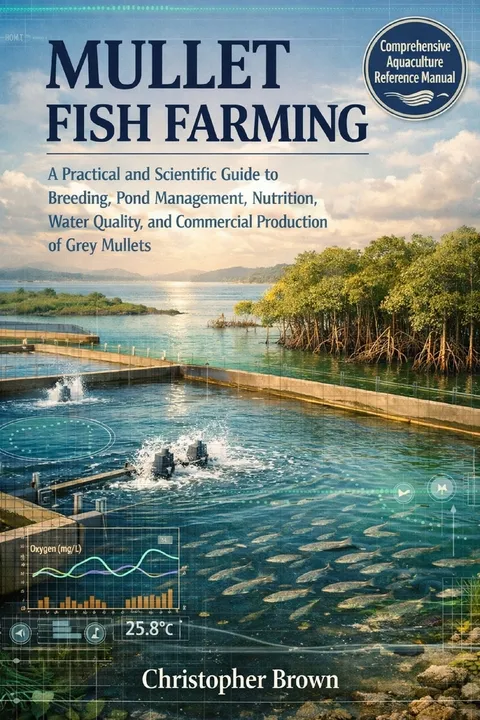
Mullet Fish Farming
A Practical and Scientific Guide to Breeding, Pond Management, Nutrition, Water Quality, and Commercial Production of Grey Mullets
Report an issue
Tell us what's wrong and we'll take a look.
Thanks – we got it. We'll review and follow up if needed.
Mullet Fish Farming by Christopher Brown, Mullet fish have occupied coastal waters, estuaries, lagoons, and river mouths for millions of years, developing a remarkable suite of biological adaptations that allow them to survive in some of the most dynamic aquatic environments on Earth. Their resilience, feeding versatility, broad salinity tolerance, and ecological efficiency have made them one of the most promising groups of fish for sustainable aquaculture. Although mullets are often overshadowed in global aquaculture by species such as salmon, catfish, and tilapia, their biological traits position them as an increasingly important resource for future food security and environmentally responsible fish production.
The family Mugilidae contains a wide variety of species commonly referred to as mullets. These fishes are distributed across tropical, subtropical, and temperate waters worldwide and have supported traditional fisheries for centuries. In many coastal communities, mullets are deeply integrated into local food systems, cultural practices, and economic activities. Their ability to thrive in both marine and brackish environments has also encouraged aquaculture development in regions where other fish species may struggle.
Understanding the biology of mullet fish is essential for anyone involved in mullet farming. Every aspect of aquaculture production, including site selection, feeding systems, stocking density, disease management, and harvesting practices, depends on biological knowledge. Farmers who fail to understand the natural physiology and ecology of mullets often encounter avoidable production problems such as poor growth rates, stress-induced mortality, inefficient feeding, and reproductive failure. Biological literacy therefore forms the foundation upon which successful mullet aquaculture is built.
The study of mullet biology extends beyond basic fish anatomy. It includes taxonomy, environmental adaptation, feeding ecology, osmoregulation, reproductive physiology, migration patterns, and ecological interactions. These biological systems interact continuously with the surrounding environment, influencing how mullets respond to temperature changes, salinity fluctuations, nutrient availability, stocking pressure, and disease exposure.
As aquaculture continues to expand globally, the need for sustainable fish species has become increasingly urgent. Intensive farming of carnivorous fish often requires high protein feeds derived from wild fish stocks, placing pressure on marine ecosystems. Mullets offer an alternative model. Their omnivorous and detritivorous feeding behavior allows them to utilize natural productivity within ponds, reducing dependence on expensive commercial feed and lowering environmental impact. This biological efficiency is one of the major reasons why mullets are attracting greater attention in modern aquaculture.
The biology of mullets also reveals important lessons about ecological balance. In natural ecosystems, these fishes function as nutrient recyclers, sediment grazers, and energy converters. By feeding on algae, organic debris, microorganisms, and suspended matter, mullets help regulate coastal nutrient cycles and improve water quality. These ecological functions translate directly into aquaculture advantages, particularly in integrated farming systems where mullets can coexist with shrimp, tilapia, or other aquatic species.
A scientific understanding of mullet biology therefore provides both practical and ecological insights. Farmers benefit from improved production efficiency, while researchers gain a deeper appreciation of the role mullets play in aquatic ecosystems. The future expansion of mullet aquaculture depends heavily on continued biological research and the application of scientific knowledge to farming practices.
Christopher Brown
Christopher Brown’s debut novel Tropic of Kansas was a finalist for the Campbell Award for best science fiction novel of 2018, and he was a World Fantasy Award nominee for the anthology Three Messages and a Warning. His short fiction and criticism has appeared in a variety of magazines and anthologies, including MIT Technology Review, LitHub, Tor.com and The Baffler. He lives in Austin, Texas, where he also practices law.
More by Christopher Brown










Why Readwise Books?
Readwise Books is an ebook & audiobook platform that automatically logs how much you and your friends read, making it fun and easy to read more. Learn more →