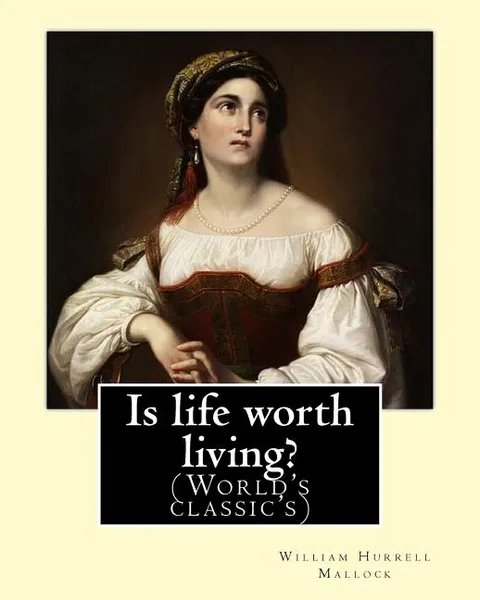
Is life worth living? By
William Hurrell Mallock: William Hurrell Mallock (7 February 1849 - 2 April 1923) was an English novelist and economics writer.
Report an issue
Tell us what's wrong and we'll take a look.
Thanks – we got it. We'll review and follow up if needed.
William Hurrell Mallock (7 February 1849 - 2 April 1923) was an English novelist and economics writer. A nephew of the historian Froude, he was educated privately and then at Balliol College, Oxford. He won the Newdigate Prize in 1872 for his poem The Isthmus of Suez and took a second class in the final classical schools in 1874, securing his Bachelor of Arts degree from Oxford University. Mallock never entered a profession, though at one time he considered the diplomatic service. He attracted considerable attention by his satirical novel, largely a symposium like Plato's Republic, The New Republic (1877), conceived while he was a student at Oxford, in which he introduced characters easily recognized as such prominent individuals as Benjamin Jowett, Matthew Arnold, Violet Fane, Thomas Carlyle, and Thomas Henry Huxley. Although the book was not well received by critics at first, it did cause instant scandal, particularly concerning the portrait of literary scholar Walter Pater: His [Pater's] first main work, Studies in the History of the Renaissance was published in 1873. Over the next three or four years it became the focus of considerable hostility towards Pater, principally reviewers objected to its amoral hedonism. Moreover, Pater was the subject of a cruel satire in W. H. Mallock's The New Republic which was published in Belgravia in 1876-7 and in book form in 1877. He appeared there as 'Mr. Rose'-an effete, impotent, sensualist with a perchant for erotic literature and beautiful young men. In the second edition of the Renaissance the 'Conclusion' was removed, partly in response to the public ridicule, but mainly because of pressure brought to bear on Pater within Oxford by figures such as Benjamin Jowett. In particular, the discovery of his 'relationship' with William Money Hardinge, a Balliol undergraduate, threatened Pater with a sexual scandal. Mallock's book appeared during the competition for the Oxford Professorship of Poetry and played a role in convincing Pater to remove himself from consideration. A few months later Pater published what may have been a subtle riposte: "A Study of Dionysus: The Spiritual Form of Fire and Dew."Mallock's New Republic was an essential book to Ronald [Knox], perhaps his favourite work of secular literature outside the classics............
William Hurrell Mallock
William Hurrell Mallock was an English novelist and economics writer, born on February 7, 1849, in Cheriton Bishop, United Kingdom. His works often reflect his support for the Roman Catholic Church and his opposition to positivist philosophy and socialism. Mallock s writing critically examines the social and political issues of his time, particularly focusing on the tensions between scientific thought and religious belief. He became known for his satirical works that challenged prevailing ideologies and promoted the values of traditional faith. Mallock's most notable works include critiques of socialism and explorations of human nature from a philosophical standpoint. He was also deeply influenced by the social and intellectual currents of the Victorian era. Mallock passed away on April 2, 1923, in Wincanton at the age of 74. His parents were Margaret Froude and William Mallock. Through his extensive writing, he left a lasting impact on the intellectual and literary landscape of his time.
More by William Hurrell Mallock


Why Readwise Books?
Readwise Books is an ebook & audiobook platform that automatically logs how much you and your friends read, making it fun and easy to read more. Learn more →