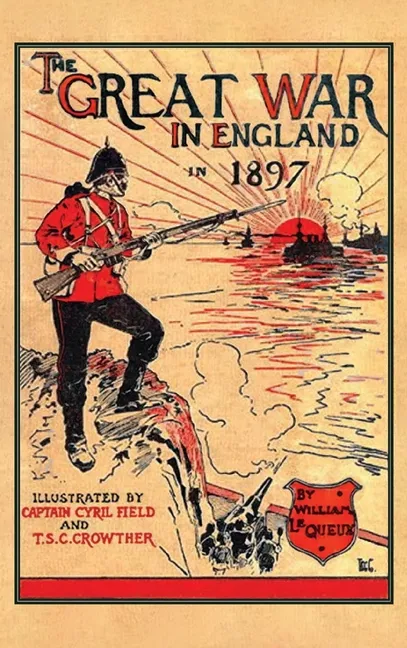
The Great War in England 1897
Report an issue
Tell us what's wrong and we'll take a look.
Thanks – we got it. We'll review and follow up if needed.
Le Queux's novel depicts Britain being invaded by coalition forces led by France and Russia, who make several early advances, but the brave English patriots fight on and eventually manage to turn the tide, especially after Germany enters the war on the side of the British. By the end of the story, the invasion goes the other way as the victors divide the spoils: Britain seizes Algeria and Russian Central Asia, thus decisively winning The Great Game, and Germany annexes more of mainland France in addition to Alsace-Lorraine, thus leaving the enemies crushed and both the British and German empires the dominant forces of Europe. From a historical perspective, the book is interesting in depicting the precise reverse of the alliances of the actual World War I which broke out two decades after its publication: France and Russia, which were to become Britain's World War I allies, are depicted as its implacable cruel foes, while Imperial Germany is the gallant ally coming to Britain's aid at the nick of time. As evidenced by the book's great popularity, the scenario of such an alliance seemed plausible to the British public in 1894; only four years later, Britain and France were indeed on the verge of war during the Fashoda Incident, an international event and the climax of imperialist territorial disputes between Britain and France in East Africa.





Why Readwise Books?
Readwise Books is an ebook & audiobook platform that automatically logs how much you and your friends read, making it fun and easy to read more. Learn more →