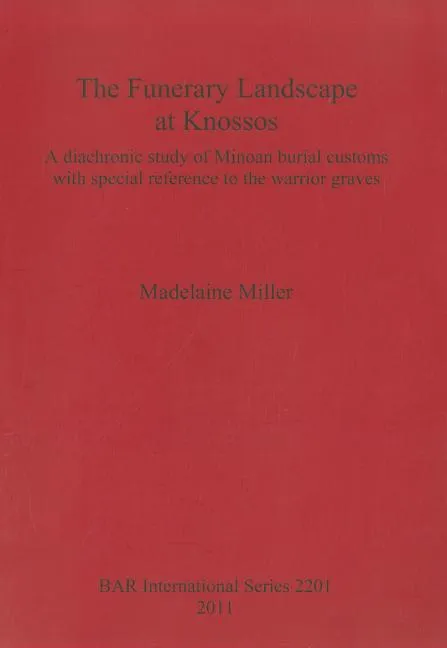
The Funerary Landscape at Knossos
A diachronic study of Minoan burial customs with special reference to the warrior graves
Report an issue
Tell us what's wrong and we'll take a look.
Thanks – we got it. We'll review and follow up if needed.
During the last century's archaeological investigations of the advanced Bronze Age culture maintained by the so-called Minoans on the island of Crete, a number of tombs dated to the Late Minoan period and containing weapons have been discovered in the surroundings of the site of Knossos. The tombs are not confined to a certain area or cemetery, but are rather dispersed around the Palace and town. Although they are characterised by their weapons, other artefacts - such as bronze vessels and certain pottery types - also distinguish these tombs. The tombs are of three types: chamber tombs with long dromoi, shaft graves and pit-caves. Various labels have been designated for them: tombs with weapons, warrior tombs, warrior graves and weapon-tombs. The warrior graves are often discussed in relation to the question of when the Mycenaeans arrived in Crete. Most scholars agree that a Mycenaean presence or power in Crete existed in the Late Bronze Age, but when their arrival would have taken place has not yet enjoyed consensus. Previous scholarship raises a number of questions that are dealt with in this work in relation to the funerary landscape at Knossos, including: to what degree do the burial customs in fact change in LM II, and what about the mainland influences? If the archaeological material points in that direction, how are we to understand such a transformation of the mortuary practices? Would this indicate an ethnic change? If, on the other hand, the material points towards a gradual process beginning already in LM I or earlier, with elements of mainland traits, what would that indicate? The tombs, shaft graves and pit-caves of Knossos are re-examined in an attempt to put answers to these intriguing questions.
Madeline Miller
Madeline Miller is the author of The Song of Achilles, which won the Orange Prize for Fiction 2012, was shortlisted for the Stonewall Writer of the Year 2012, was an instant New York Times bestseller, and was translated into twenty-five languages. Madeline holds an MA in Classics from Brown University, and she taught Latin, Greek and Shakespeare to high school students for over a decade. She has also studied at the University of Chicago's Committee on Social Thought, and at Yale School of Drama, where she focused on the adaptation of classical texts to modern forms. Her essays have appeared in publications including the Guardian, Wall Street Journal, Lapham's Quarterly and NPR.org. She lives outside Philadelphia.
madelinemiller.com
More by Madeline Miller


Why Readwise Books?
Readwise Books is an ebook & audiobook platform that automatically logs how much you and your friends read, making it fun and easy to read more. Learn more →