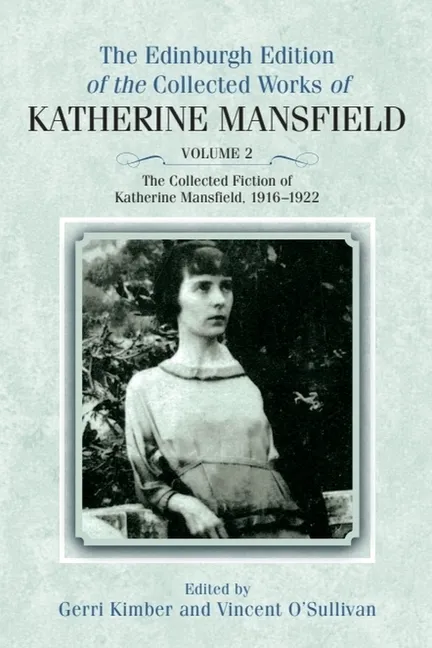
The Collected Fiction of Katherine Mansfield, 1916-1922
Report an issue
Tell us what's wrong and we'll take a look.
Thanks – we got it. We'll review and follow up if needed.
These two volumes collect together 215 of Mansfield's stories and expand considerably upon the largest previous single collected edition of 85 stories. They include Mansfield's best-loved stories, stories uncollected, unpublished or left incomplete during her lifetime, the full text of The Aloe, from which Mansfield shaped her ground-breaking work Prelude, and her own manuscript versions of several stories later 'edited' by her husband, John Middleton Murry. The volumes are arranged in chronological order, so that readers can trace Mansfield's progress as a creative writer, month-by-month, from her first schoolgirl story in 1898 to her last completed story in July 1922.
Mansfield will be read differently, and more accurately, as a result of this edition. The annotations and their cross-referencing to her letters and notebooks deepen what we know of the context and genesis of her fiction. This edition is testament to Mansfield's importance among twentieth century English-language writers and to her rare and original handling of the short story form.
Key Features:
Brings together for the first time all of Mansfield's extant fictionRefocuses critical attention on one of the most influential exponents of modernist fictionThe essential Mansfield text for individual scholars working on Mansfield studies, as well as those with a more general interest in Mansfield the writerRedefines Mansfield as a writer for the next generationThe Edinburgh Edition of the Collected Works of Katherine Mansfield, Volumes 1-4
Katherine Mansfield
Katherine Mansfield was a popular New Zealand short-story writer best known for the stories "The Woman at the Shore," "How Pearl Button Was Kidnapped," "The Doll’s House," and her twelve-part short story "Prelude," which was inspired by her happy childhood. Although Mansfield initially had her sights set on becoming a professional cellist, her role as editor of the Queen’s College newspaper prompted a change to writing. Mansfield’s style of writing revolutionized the form of the short story at the time, in that it depicted ordinary life and left the endings open to interpretation, while also raising uncomfortable questions about society and identity. Mansfield died in 1923 after struggling for many years with tuberculosis.
More by Katherine Mansfield








Why Readwise Books?
Readwise Books is an ebook & audiobook platform that automatically logs how much you and your friends read, making it fun and easy to read more. Learn more →