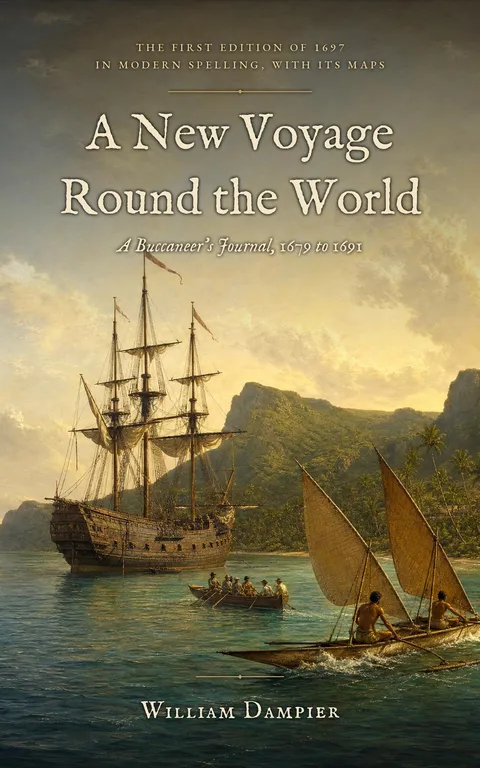
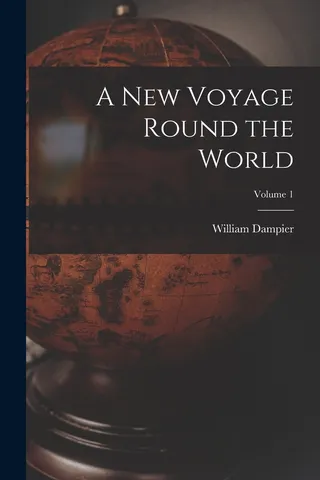
A New Voyage Round the World
Report an issue
Tell us what's wrong and we'll take a look.
Thanks – we got it. We'll review and follow up if needed.
In 1679 a young seaman from Somerset joined the buccaneers of the Caribbean. Twelve years later William Dampier came home to England with little more than his journal. He had carried it across the Isthmus of Darién in a joint of bamboo sealed with wax, and on through raids, storms, hunger and mutiny, all the way round the world.
Published in 1697, A New Voyage Round the World made him famous. It takes the reader round Cape Horn to Juan Fernández, where the buccaneers found a Miskito man named Will who had lived there alone for three years, then to the giant tortoises of the Galápagos, to raids on the Spanish towns of Peru and Mexico, and to a vain wait for the treasure fleet off Panama. In 1686 Dampier's ship crossed the Pacific to Guam so short of food that the crew had planned to eat their captain first. It sailed on to Mindanao, where the men mutinied and left that captain behind, then to the coasts of Vietnam and China and to the unknown shores of New Holland, now Australia. From the Nicobar Islands, Dampier and a few companions set out for Sumatra in an open canoe and barely survived the storm that caught them.
Dampier was a buccaneer with the eye of a naturalist, and his book is adventure story, natural history and sailing directions in one. He describes winds and currents, harbors, plants, animals and peoples with a care that won him the attention of the Royal Society and, soon after, command of a Royal Navy ship sent to explore New Holland. The book went through four editions in three years. Defoe and Swift read him, and Gulliver himself calls him "my cousin Dampier." His pages are among the first in English to use words such as avocado and barbecue. He went on to sail round the world twice more.
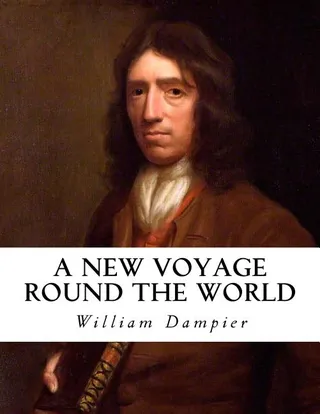
This edition gives the complete text of the first edition of 1697, checked against two copies of the original. Spelling and punctuation are modernized for today's reader, but the words are Dampier's own. The corrections in the 1697 list of errata are made in the text, and a handful of obvious errors are put right from the second and fourth editions. Place names appear in their modern forms wherever they can be identified, with a gazetteer of the names Dampier used. The book includes all the original maps and engravings, among them Herman Moll's map of the world tracing the voyage. It adds Dampier's portrait, a glossary of sea terms and old words, the 1697 table of contents, the bookseller's advertisements, and transcriber's notes that record every place where a later edition was used or a word was changed. Dampier's words for the peoples he met are kept as he wrote them, with a note.




Why Readwise Books?
Readwise Books is an ebook & audiobook platform that automatically logs how much you and your friends read, making it fun and easy to read more. Learn more →