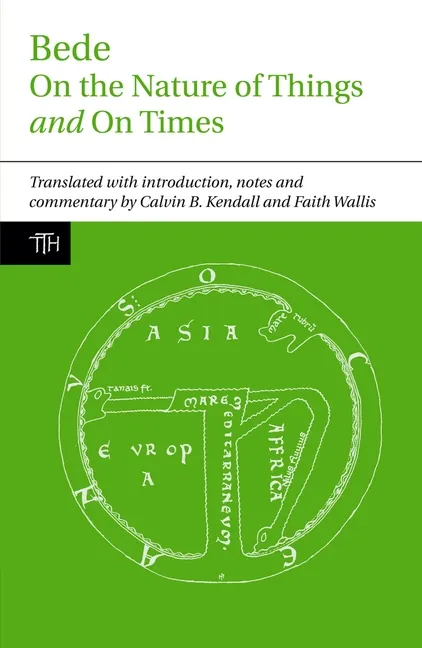
Bede: On the Nature of Things and on Times
Report an issue
Tell us what's wrong and we'll take a look.
Thanks – we got it. We'll review and follow up if needed.
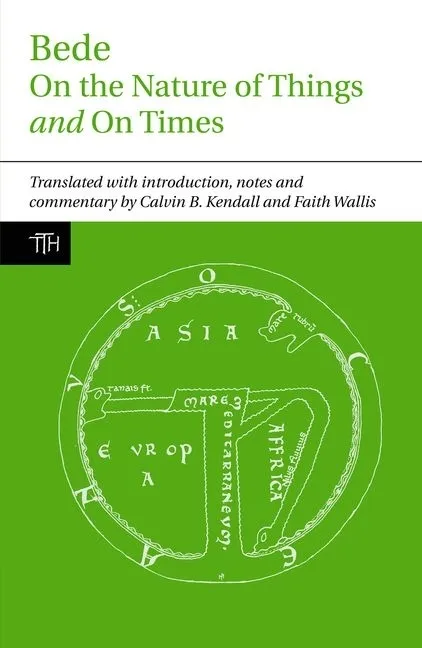
The Venerable Bede composed On the Nature of Things (De natura rerum) and On Times (De temporibus) at the outset of his career, about AD 703. Bede fashioned himself as a teacher to his people and his age, and these two short works show him selecting, editing, and clarifying a mass of difficult and sometimes dangerous material. He insisted that his reader understand the mathematical and physical basis of time, and though he was dependent on his textual sources, he also included observations of his own. But Bede was also a Christian exegete who thought deeply and earnestly about how salvation-history connected to natural history and the history of the peoples of the earth. To comprehend his religious mentality, we have to take on board his views on "science" ---- and vice versa.
On the Nature of Things is a survey of cosmology. Starting with Creation and the universe as a whole, Bede reads the cosmos downwards from the heavens, through the atmosphere, to the oceans and rivers of earth. This order (recapitulating the four elements or fire, air, water and earth) was derived from his main source, Isidore of Seville's On the Nature of Things. However, Bede separated out Isidore's chapters on time, and dealt with them in On Times. On Times, like its "second, revised and enlarged edition" The Reckoning of Time (De temporum ratione), works upwards from the smallest units of time, through the day and night, the week, month and year, to the world-ages. Bede's innovation is to introduce a practical manual of Easter reckoning, or computus, into this survey. Hidden beneath the matter-of-fact surface of the work is an intense polemic about the correct principles for determining the date of Easter ---- principles which in Bede's view are bound up with both the integrity of nature as God's creation, and the theological significance of Christ's death and resurrection. In these works Bede re-united cosmology and time-reckoning to form a unified science of computus that would become the framework for Carolingian and Scholastic basic scientific education.
Bede
Bede devoted his life to learning, faith, and the careful recording of history. Born around 673 in Northumbria, he spent nearly his entire life in a monastery, immersed in study and teaching. A deep commitment to faith and scholarship shaped his philosophy, uniting religious devotion with a passion for knowledge.Careful observation and clear writing define the heart of his work. In works such as Ecclesiastical History of the English People, he traced the growth of Christianity in England with detail and purpose. Thoughtful storytelling blends history and faith, revealing a belief in divine order guiding human events.Enduring influence has made him one of the most important early historians of medieval Europe. Scholars relied on his work for centuries as a foundation for understanding early English history. Today, his writings remain widely valued for their clarity, reliability, and lasting historical significance.
More by Bede




Calvin B Kendall
Translated by
Calvin B. Kendall is Morse-Alumni Distinguished Teaching Professor of English, University of Minnesota.


Why Readwise Books?
Readwise Books is an ebook & audiobook platform that automatically logs how much you and your friends read, making it fun and easy to read more. Learn more →