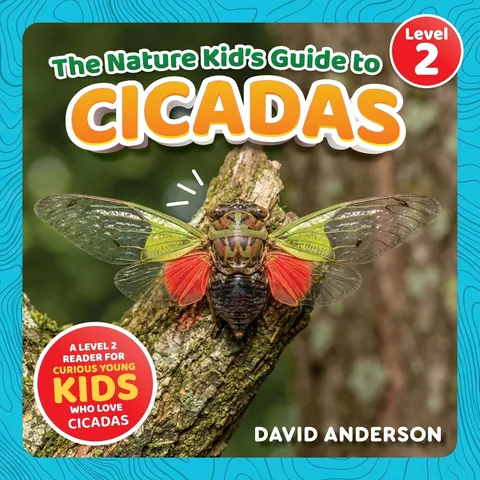
The Nature Kid's Guide to Cicadas
A Level 2 Reader for Curious Young Kids Who Love Cicadas!
Report an issue
Tell us what's wrong and we'll take a look.
Thanks – we got it. We'll review and follow up if needed.
Dig, dig, dig! On one warm spring night, millions of insects push up through the ground at exactly the same moment. They're cicadas, and they've been waiting underground for the past 17 years!
If your child thinks cicadas are just noisy summer bugs, this book is about to change everything. A single male cicada sings at 100 decibels, as loud as a lawnmower right next to your ear, and has to turn off his own hearing while doing it or the noise would damage his ears. Their 13 and 17-year underground cycles are both prime numbers, which scientists believe confuses every predator on Earth. A mass emergence can pack over one million cicadas into a single acre of land. A mother lays up to 600 eggs in a tree branch and flies away forever, leaving each nymph to find its way underground completely alone. Every page delivers something your child will want to run and share.
"The Nature Kid's Guide to Cicadas" is written for curious kids ages 7-12 who want to know the real story behind one of nature's most extraordinary insects. How does an insect that spends 17 years doing almost nothing underground know the exact moment to dig up and join millions of others? Why do cicadas choose prime numbers for their life cycles? What makes a chorus of millions so loud that people inside their homes with windows shut can still hear every note? Your child will find out, and they will never hear that summer buzz the same way again.
Short sentences and surprising facts build reading confidence while keeping even older kids hooked from first page to last. Chapters cover everything from sap drinking and shell shedding to love songs, mass emergences, and the remarkable solo journey every nymph makes from treetop to underground on its very first day of life.
A book for every kid who has ever heard that deafening summer buzz and had absolutely no idea what was making it.
There are more than 3,000 species of cicadas on Earth, and somewhere underground right now, millions of them are quietly waiting for the soil to hit 64 degrees. That is the kind of wonder that sticks.
Thousands of young readers have explored the Nature Kids Guide series. Your child is next!
David Anderson
David Anderson has been at the leading edge of the technology industry for twenty-five years. Starting as a Software Engineer in leading telecom companies (including Three, Nokia, and Ericsson), David moved to Liberty Mutual in 2007 and continued to drive technology change and raise engineering standards. As Director of Technology, David had exposure to a wide range of technologies and techniques covering Architecture, Software Development, Leadership, AI/Analytics, and Cyber-Security. David was involved in the early phases of Public Cloud adoption at Liberty Mutual in 2013 and continued to drive the change. Creating the Serverless-First strategy in 2016, he was able to achieve significant, multi-million-dollar business results, create a new, industry-leading engineering standard within Liberty Mutual and to lead a generation of architects to become cloud leaders in their own right. David is also a member of the Wardley Mapping community and has been involved in many efforts, discussions, and sessions/research groups to further this strategic approach.
In 2021, David parted from Liberty Mutual to explore the serverless first journey across the industry and joined BazaarVoice as Technical Fellow. The Serverless Edge was formed to collate some of this thinking, and he continues to work with clients and partners to prove out the thinking in this book.
More by David Anderson











Why Readwise Books?
Readwise Books is an ebook & audiobook platform that automatically logs how much you and your friends read, making it fun and easy to read more. Learn more →