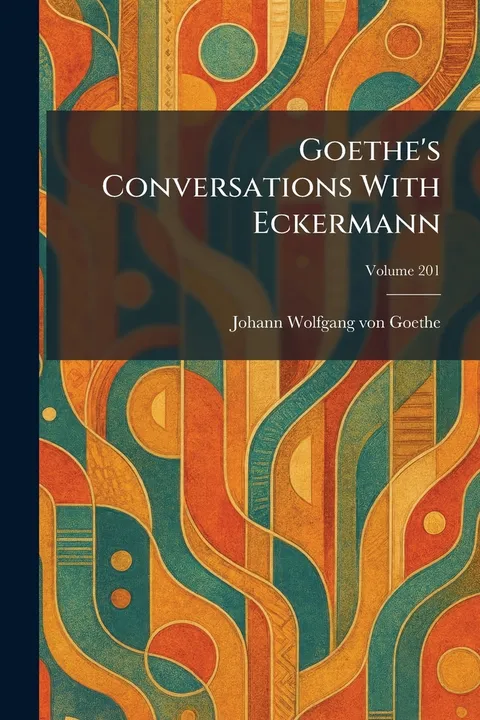
Goethe's Conversations With Eckermann
Report an issue
Tell us what's wrong and we'll take a look.
Thanks – we got it. We'll review and follow up if needed.
"Goethe's Conversations With Eckermann" provides an intimate and expansive look into the final decade of the life of Johann Wolfgang von Goethe, arguably the greatest literary figure of the German language. Faithfully recorded by his close associate, Johann Peter Eckermann, these dialogues serve as a vital primary source for understanding the intellectual landscape of the early 19th century. Through these pages, readers encounter Goethe's reflections on a diverse range of subjects, from the principles of world literature and the nuances of poetic craft to his pioneering theories on color and natural science.
As a foundational text of Weimar Classicism, this work captures the wisdom of a polymath at the height of his maturity. The conversations reveal Goethe's interactions with the works of contemporaries such as Byron, Schiller, and Scott, alongside his musings on philosophy, art history, and human nature. This volume is more than a biographical account; it is a profound exploration of a mind that sought to synthesize art and science into a unified worldview. For students of literature, history, and philosophy, "Goethe's Conversations With Eckermann" remains an essential companion to the study of one of history's most influential thinkers.
This work has been selected by scholars as being culturally important, and is part of the knowledge base of civilization as we know it. This work was reproduced from the original artifact, and remains as true to the original work as possible. Therefore, you may see the original copyright references, library stamps (as most of these works have been housed in our most important libraries around the world), and other notations in the work.
This work is in the public domain in the United States of America, and possibly other nations. Within the United States, you may freely copy and distribute this work, as no entity (individual or corporate) has a copyright on the body of the work.
As a reproduction of a historical artifact, this work may contain missing or blurred pages, poor pictures, errant marks, etc. Scholars believe, and we concur, that this work is important enough to be preserved, reproduced, and made generally available to the public. We appreciate your support of the preservation process, and thank you for being an important part of keeping this knowledge alive and relevant.
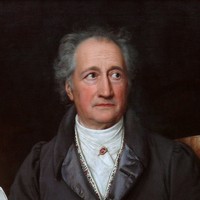
Johann Wolfgang von Goethe
Johann Wolfgang von Goethe was a German writer, poet, playwright, and philosopher, widely regarded as one of the most influential figures in Western literature. Born on August 28, 1749, in Frankfurt, Germany, he is best known for his works such as Faust, The Sorcerer's Apprentice, and Erlkönig. Goethe's works span a wide range of genres, including drama, poetry, and philosophy, and he was a central figure in the Sturm und Drang literary movement. His writing not only revolutionized German literature but also had a profound impact on political and philosophical thought. Throughout his career, Goethe was influenced by figures such as Friedrich Schiller and William Shakespeare, and his ideas on individuality and the human condition helped shape European intellectual history. Goethe was married to Christiane Vulpius from 1806 until her death in 1816. He spent much of his life in Weimar, Germany, where he died on March 22, 1832, at the age of 82. His legacy continues to influence writers, artists, and thinkers across the globe. His exploration of human nature and existential questions remains relevant in modern cultural and intellectual discussions.
More by Johann Wolfgang von Goethe




Why Readwise Books?
Readwise Books is an ebook & audiobook platform that automatically logs how much you and your friends read, making it fun and easy to read more. Learn more →