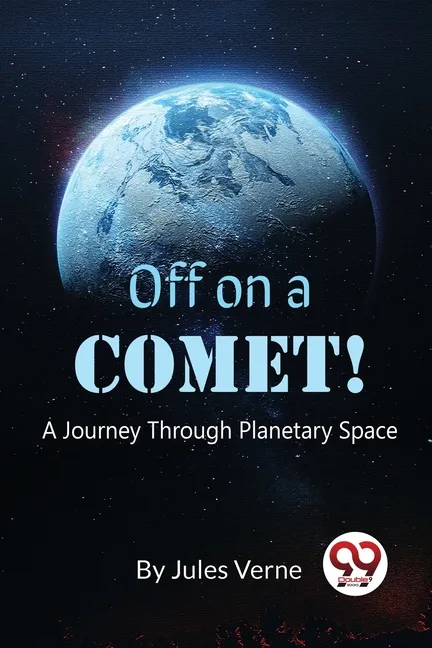
Off On A Comet! A Journey Through Planetary Space
Report an issue
Tell us what's wrong and we'll take a look.
Thanks – we got it. We'll review and follow up if needed.
The story opens when a comet named Gallia collects a few tiny bits of Earth while passing by it in midair. The disaster occurred close to Gibraltar on January 1st, 1885. There are still 36 people in the territory the comet has occupied who are of French, English, Spanish, and Russian nationalities. At first, they don't know what's happened and think there's been an earthquake instead of a collision. Adjutant Ben Zoof for Captain Servadac surprises himself by jumping 12 meters (39 feet) in the air as the first indication of weight loss. Soon after, Zoof and Servadac also observe that there are only six hours between day and night, that east and west have switched places, and that water begins to boil at 66 °C (151 °F), from which they correctly deduce that the atmosphere has thinned and the pressure has reduced. They observe the Earth and the Moon when they first arrive at Gallia, but they incorrectly think it is a newly discovered planet. Their research expedition, which included a ship that the comet also captured, produced additional important data.

Jules Verne
Jules Verne (1828-1905) is considered by many the father of science fiction. Born in Nantes, France, he studied law but turned to writing opera libretti until the 1863 publication of Five Weeks in a Balloon, the first of his Extraordinary Voyages series. Its success encouraged him to produce a number of classic and prophetic science fiction novels, including Journey to the Center of the Earth and Twenty Thousand Leagues under the Sea. His stories foresaw many scientific and technological developments, including the submarine, television, and space travel.
More by Jules Verne








Why Readwise Books?
Readwise Books is an ebook & audiobook platform that automatically logs how much you and your friends read, making it fun and easy to read more. Learn more →