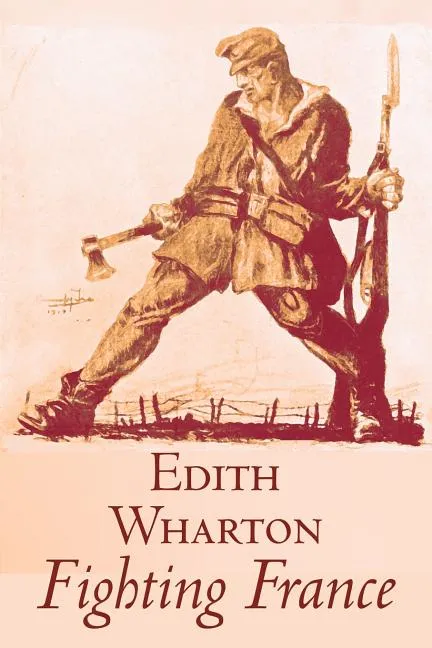
Fighting France by Edith Wharton, History, Travel, Military, Europe, France, World War I
Report an issue
Tell us what's wrong and we'll take a look.
Thanks – we got it. We'll review and follow up if needed.
On the 30th of July, 1914, motoring north from Poitiers, we had lunched somewhere by the roadside under apple-trees on the edge of a field. Other fields stretched away on our right and left to a border of woodland and a village steeple. All around was noonday quiet, and the sober disciplined landscape which the traveller's memory is apt to evoke as distinctively French. Sometimes, even to accustomed eyes, these ruled-off fields and compact grey villages seem merely flat and tame; at other moments the sensitive imagination sees in every thrifty sod and even furrow the ceaseless vigilant attachment of generations faithful to the soil. The particular bit of landscape before us spoke in all its lines of that attachment. The air seemed full of the long murmur of human effort, the rhythm of oft-repeated tasks, the serenity of the scene smiled away the war rumours which had hung on us since morning. . . .
Edith Wharton
Edith Wharton (1862-1937) was born into a distinguished New York family and was educated privately in the United States and abroad. Among her best-known work is Ethan Frome (1911), which is considered her greatest tragic story, The House of Mirth (1905), and The Age of Innocence (1920), for which she was awarded the Pulitzer Prize.
More by Edith Wharton








Why Readwise Books?
Readwise Books is an ebook & audiobook platform that automatically logs how much you and your friends read, making it fun and easy to read more. Learn more →