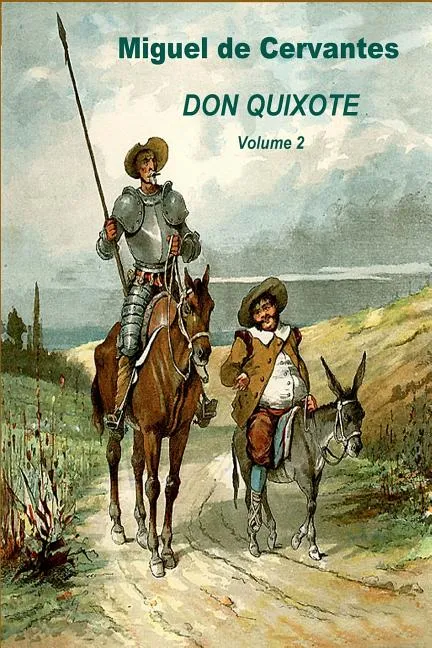
Don Quixote Volume 2
Report an issue
Tell us what's wrong and we'll take a look.
Thanks – we got it. We'll review and follow up if needed.
Don Quixote (spelled "Quijote" in modern Spanish) is two separate volumes, now nearly always published as one, that cover the adventures of Don Quixote, also known as the knight or man of La Mancha, a hero who carries his enthusiasm and self-deception to unintentional and comic ends. On one level, Don Quixote works as a satire of the romances of chivalry, which, though still popular in Cervantes' time, had become an object of ridicule among more demanding critics. The choice of a madman as hero also served a critical purpose, for it was "the impression of ill-being or 'in-sanity, ' rather than a finding of dementia or psychosis in clinical terms, that defined the madman for Cervantes and his contemporaries." Indeed, the concept of madness was "associated with physical or moral displacement, as may be seen in the literal and figurative sense of the adjectives eccentric, extravagant, deviant, aberrant, etc."[35] The novel allows Cervantes to illuminate various aspects of human nature.Don Quixote is noble-minded, an enthusiastic admirer of everything good and great, yet having all these fine qualities accidentally blended with a relative kind of madness. He is paired with a character of opposite qualities, Sancho Panza, a man of low self-esteem, who is a compound of grossness and simplicity. Don Quixote is cited as the first classic model of the modern romance or novel, and it has served as the prototype of the comic novel. The humorous situations are mostly burlesque, and it includes satire. Don Quixote is one of the Encyclop?dia Britannica's Great Books of the Western World, while the Russian author Fyodor Dostoyevsky called it "the ultimate and most sublime work of human thinking".[36] It is in Don Quixote that Cervantes coined the popular phrase "the proof of the pudding is in the eating" (por la muestra se conoce el pano), which still sees heavy use in the shortened form of "the proof is in the pudding", and "who walks much and reads much, knows much and sees much" (quien anda mucho y lee mucho, sabe mucho y ve mucho). Includes unique illustrations!
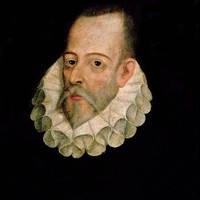
Miguel de Cervantes
Miguel de Cervantes was born on September 29, 1547, in Alcala de Henares, Spain. At twenty-three he enlisted in the Spanish militia and in 1571 fought against the Turks in the Battle of Lepanto, where a gunshot wound permanently crippled his left hand. He spent four more years at sea and then another five as a slave after being captured by Barbary pirates. Ransomed by his family, he returned to Madrid but his disability hampered him; it was in debtor's prison that he began to write Don Quixote. Cervantes wrote many other works, including poems and plays, but he remains best known as the author of Don Quixote. He died on April 23, 1616.
More by Miguel de Cervantes





Why Readwise Books?
Readwise Books is an ebook & audiobook platform that automatically logs how much you and your friends read, making it fun and easy to read more. Learn more →