
Shirley, By Charlotte Brontë
Report an issue
Tell us what's wrong and we'll take a look.
Thanks – we got it. We'll review and follow up if needed.

This work has been selected by scholars as being culturally important, and is part of the knowledge base of civilization as we know it.
This work is in the "public domain in the United States of America, and possibly other nations. Within the United States, you may freely copy and distribute this work, as no entity (individual or corporate) has a copyright on the body of the work.
Scholars believe, and we concur, that this work is important enough to be preserved, reproduced, and made generally available to the public. We appreciate your support of the preservation process, and thank you for being an important part of keeping this knowledge alive and relevant.
Charlotte Brontë
Charlotte Brontë (1816-1855) grew up in the isolated parsonage at Haworth, Yorkshire, where her father was curate. She and her sisters Emily and Anne thrived in fantasy worlds that drew on their voracious reading of Shakespeare, romantic, and gothic fiction. Charlotte was employed as a teacher and a governess before she began writing with her sisters. The Professor, her first novel, was rejected for publication until 1857, although Jane Eyre, published in 1847 under a pseudonym, achieved great success.
More by Charlotte Brontë












Anne Brontë
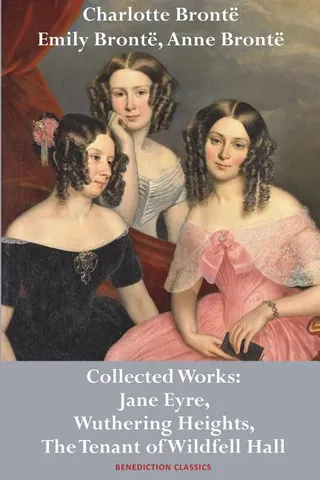
Anne Brontë (1820-1849) was an English novelist and poet, the youngest of the literary Brontë sisters. She worked as a governess and published Agnes Grey and The Tenant of Wildfell Hall, along with poems by Currer, Ellis, and Acton Bell.The conditions of the writer's period are important to an understanding of the work. Questions about the individual and society, including the roles of education, work, belief, and public institutions, repeatedly enter the literature and intellectual debates of the era. The historical setting should not be confused with a modern retelling: the language and assumptions of these works belong to their original moment.Anne grew up at Haworth parsonage in Yorkshire, in a family closely connected to reading and imaginative writing. Like her sisters Charlotte and Emily, she initially published under a masculine pseudonym: Acton Bell. The sisters' joint collection Poems by Currer, Ellis, and Acton Bell appeared in 1846. Anne's work as a governess gave her unusually direct knowledge of the economic vulnerability and isolation that shaped the lives of educated women dependent on employment in private households. Agnes Grey, her first novel, appeared in 1847 in a volume alongside Emily's Wuthering Heights. Its restraint and social observation differ from the more sensational reputation often associated with the Brontë name. Anne's second novel, The Tenant of Wildfell Hall, appeared in 1848 and engaged more directly with marriage, alcoholism, and a woman's moral autonomy. She died of tuberculosis in Scarborough the following year, leaving a small but distinctive body of fiction and poetry.In Agnes Grey, the writer turns to victorian domestic realism to develop a particular subject. Anne Brontë drew on experience as a governess to expose the precarious position of educated working women. Its achievement is best understood in connection with the author's established body of writing and the literary conventions through which the subject is presented.Readers approaching this work today can appreciate its historical frame alongside its literary ambitions. Its treatment of character, perspective, society, or argument offers insight into the concerns that shaped its original audience. Where names, dates, or the original author's identity are uncertain, those details should be resolved through the edition and bibliographical record rather than supplied by conjecture.
More by Anne Brontë







Why Readwise Books?
Readwise Books is an ebook & audiobook platform that automatically logs how much you and your friends read, making it fun and easy to read more. Learn more →