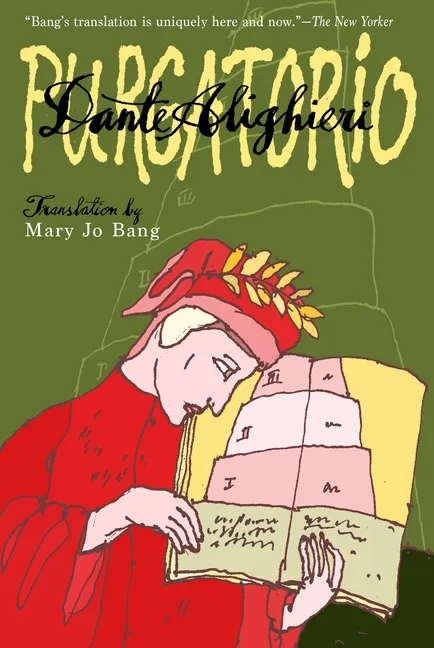
Purgatorio
Report an issue
Tell us what's wrong and we'll take a look.
Thanks – we got it. We'll review and follow up if needed.

The second installment in Mary Jo Bang's exhilarating, innovative translation of Dante's The Divine Comedy
Award-winning poet Mary Jo Bang's new translation of Purgatorio is the extraordinary continuation of her journey with Dante, which began with her transformative version of Inferno. In Purgatorio, still guided by the Roman poet Virgil, Dante emerges from the horrors of Hell to begin the climb up Mount Purgatory, a seven-terrace mountain with each level devoted to those atoning for one of the seven deadly sins. At the summit, we find the Terrestrial Heaven and Beatrice--who will take over for Virgil, who, as a pagan, can only take Dante so far. During the climb, we are introduced to the myriad ways in which humans destroy the social fabric through pride, envy, and vindictive anger.
In her signature lyric style, accompanied by her wise and exuberant notes, Bang has produced a stunning translation of this fourteenth-century text, rich with references that span time, languages, and cultures. The contemporary allusions echo the audacious character of the original, and slyly insist that whatever was true in Dante's era is still true. Usain Bolt, Tootsie Fruit Chews, the MGM logo, Leo the Lion, Amy Winehouse, Marvin Gaye, Bob Dylan, and Gertrude Stein are among those who make cameo appearances as Bang, with eloquence and daring, shepherds The Divine Comedy into the twenty-first century.
Dante
Dante was born in Florence, Italy, in 1265. Heir of a poor but noble family, he was one of the seven elected officials in charge of the government of Florence. Civil war was common in Florence at the time and the issues were further complicated by the question of Papal influence. In 1300, Dante along with his fellow magistrates confirmed anti-papal measures. When in 1302, the French prince acting under orders from the Pope captured power in Florence, Dante was sentenced on charges of corruption and opposition to the Church and exiled from Florence on pain of execution by burning if he ever returned. He spent the rest of his life in exile, pining for his native city. He withdrew from active politics to a large extent and concentrated on his literary creations.
We do not know exactly when Dante began work on The Divine Comedy. He had been moving about from court to court after his exile and 1n 1317 had settled at Ravenna, where he completed his great work. Extant correspondence shows that the first and second parts of The Divine Comedy, the "Inferno" and the "Purgatario" were generally known around 1319. The last part, the "Paradiso" was completed only in 1321. Dante died at Ravenna on 14 September 1321 and the last thirteen Cantos of the "Paradiso" were published posthumously.
More by Dante






Why Readwise Books?
Readwise Books is an ebook & audiobook platform that automatically logs how much you and your friends read, making it fun and easy to read more. Learn more →