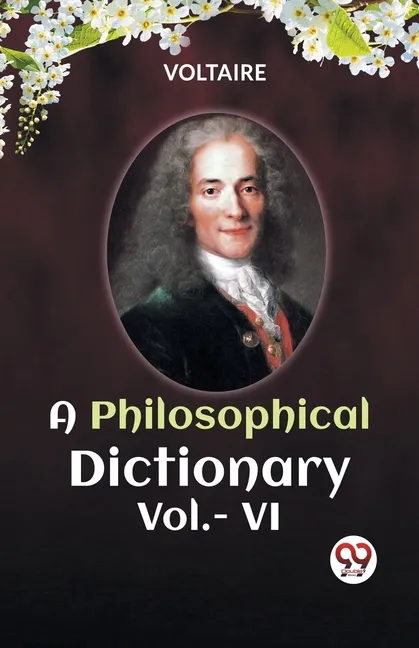
A PHILOSOPHICAL DICTIONARY Vol.- VI
Report an issue
Tell us what's wrong and we'll take a look.
Thanks – we got it. We'll review and follow up if needed.
"A PHILOSOPHICAL DICTIONARY VOL. VI" is the maximum essential work of his time because it indicates how sharply he could chortle at and criticize the thoughts and establishments of his time. As a set of articles and entries, this philosophical dictionary gives you a full have a look at Voltaire's thoughts on a wide range of subjects, which include faith, government, science, and human nature. In the primary book, Voltaire uses his signature sarcastic fashion to interrupt down non-secular dogmas and traditional beliefs and call for purpose and tolerance. He talks about such things as theocracy, superstition, and religious hatred, and he helps a wiser and greater affordable way of coping with issues in society. The beliefs of the Enlightenment, like cause, man or woman freedom, and the look for knowledge, may be seen in Voltaire's writing. Voltaire's expertise is apparent at some stage in the dictionary, as he draws on a huge variety of sources, such as historical occasions, literature, and clinical reveals. There is a mixture of seriousness and sarcasm in his work, which makes complex thoughts reachable to a much wider audience. "A PHILOSOPHICAL DICTIONARY VOL. VI" is an instance of Voltaire's highbrow legacy. It demanding situations the status quo and fights for highbrow freedom and open research.
Voltaire
Voltaire (1694–1778) was the pseudonym of François-Marie Arouet, one of the most prominent writers and thinkers of the Enlightenment. After studying at the Collège de Clermont (now the Lycée Louis-le-Grand), he began writing philosophical works as well as poems, comedic plays, and other forms of literature. Voltaire was often imprisoned for publicly criticizing the French monarchy. His controversial beliefs included religious freedom, freedom of expression, and separation of church and state.
More by Voltaire













Why Readwise Books?
Readwise Books is an ebook & audiobook platform that automatically logs how much you and your friends read, making it fun and easy to read more. Learn more →