Report an issue
Tell us what's wrong and we'll take a look.
Thanks – we got it. We'll review and follow up if needed.
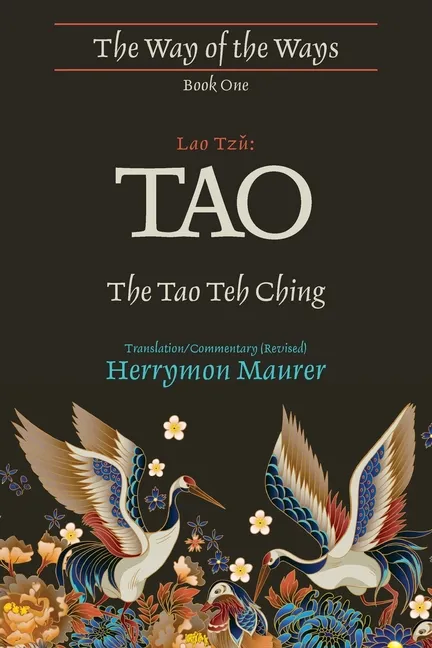
Herrymon Maurer (1914-1998) has created a remarkable new translation of the Tao Teh Ching, inspired by a Quaker understanding of simplicity and religious experience and informed by his immersion in Chinese culture during a 1939-1941 sojourn in rural Sichuan province with his young family. The translation strives to preserve many of the Chinese metaphors as well as the directness of the sacred text and to find English phrases that render, at least to some extent, the beauty and economy of Lao Tzŭ's original. Maurer's masterful commentary helps clarify phrases that may baffle Westerners as he weaves together insights from Christianity, Judaism and Islam to situate the Tao in a context of universal humility and hope. A member of Alcoholics Anonymous, the author was acquainted with the destructive power of self, but had also discovered that the self can learn to live in relationship. First published in 1982, this revised edition of Maurer's translation and expanded commentary on Lao Tzŭ's enduring attempt to proclaim the Way of the Ways is published posthumously by family and friends who share the author's hope that it may be useful to other seekers, as suggested by Chapter 4:
Tao is empty! Use it
And it isn't used up.
Deep! It seems like
The forbear of the ten thousand things.
It blunts edges,
Unties tangles,
Harmonizes lights,
Unites all dusts.
Existent and deep!
I don't know whose child it is.
It looks to be the source.
Lao Tzu
Lao Tzu stands as a mysterious and enduring figure whose ideas shaped one of the world's great philosophical traditions. Said to have lived in ancient China, he is traditionally regarded as the author of Tao Te Ching, though his historical existence remains uncertain. A philosophy centered on harmony with the natural "Way" guided his thought, emphasizing simplicity, humility, and effortless action.Gentle paradox and quiet wisdom flow through the core of his teachings. In works such as Tao Te Ching, he presents ideas of balance, non-action (wu wei), and living in accordance with nature rather than resisting it. Fluid insights reveal that strength often lies in softness, and that true understanding comes from letting go rather than striving.Enduring influence has made him a foundational figure in Chinese philosophy and spiritual thought. Taoism grew from his ideas, shaping culture, religion, and ways of life across centuries. Today, his work remains widely read, valued for its depth, mystery, and timeless guidance on how to live in harmony with the world.
More by Lao Tzu


Why Readwise Books?
Readwise Books is an ebook & audiobook platform that automatically logs how much you and your friends read, making it fun and easy to read more. Learn more →