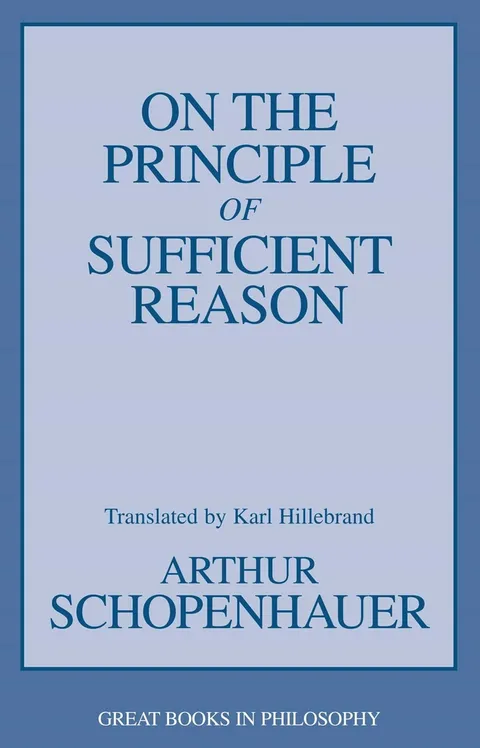
On the Principle of Sufficient Reason
Report an issue
Tell us what's wrong and we'll take a look.
Thanks – we got it. We'll review and follow up if needed.
"Schopenhauer's analyses of causation and related concepts ... rival and probably surpass in their depth and brilliance the more celebrated discussions of David Hume. Where Hume grossly oversimplified these problems and left them riddled with paradoxes, Schopenhauer disentangled them and shed light on what had seemed hopelessly dark" - Richard TaylorThis little-known work by the famous German pessimist and critic of Hegel was originally written as a doctoral dissertation when Schopenhauer was just twenty-six, but it was later revised when the philosopher was sixty. So important did he consider this work, originally titled "On the Fourfold Root of the Principle of Sufficient Reason," that he often underscored the fact that no one could hope to understand his magnum opus, The World as Will and Representation, without having first read this work. Schopenhauer takes up where Kant left off in response to Hume, and his insights into the nature of perception and understanding remain amazingly relevant and still unsurpassed."Our knowing consciousness, which manifests itself as outer and inner sensibility (or receptivity) and as understanding and reason, subdivides itself into subject and object and contains nothing else. To be object for the subject and to be our representation are the same thing. All our representations stand towards one another in a regulated connection, which may be determined a priori, and on account of which nothing existing separately and independently, nothing single or detached, can become an object for us. It is this connection which is expressed by the Principle of Sufficient Reason in its generality." - chapter 3, §16
Arthur Schopenhauer
German philosopher Arthur Schopenhauer was born in 1788 and died on September 21, 1860. Although Schopenhauer's work received little attention while he was alive, it had an influence on several fields after his death, including science, literature, and philosophy. Numerous writers and artists have been impacted by his writing on psychology, ethics, and aesthetics. At the age of 88, Arthur Schopenhauer passed away in Paris in 1848. He was born in Danzig, Germany, in 1788 on Heiligegeistgasse. He was the son of Heinrich Floris Schopenhauer (1747-1805) and Johanna Schopenhauer (née Trosiener; 1766-1838), who were both descended from affluent German-Dutch aristocratic families. Arthur was brought to Le Havre in 1797 to live with Grégoire de Blésimaire's family, a business acquaintance of his father's. In 1811-1812, Schopenhauer studied philosophy at the recently established University of Berlin. Schopenhauer periodically mentioned his wish to get married and start a family when he was living in Berlin. He had an on-and-off relationship with Caroline Richter, who had had numerous lovers and a son out of wedlock. After arriving in Frankfurt, he went through a depressive episode and his health deteriorated. He passed away at home, seated on his sofa, on September 21, 1860, from pulmonary-respiratory failure. He passed away at the age of 72, and a Lutheran preacher officiated at his funeral.
More by Arthur Schopenhauer





Why Readwise Books?
Readwise Books is an ebook & audiobook platform that automatically logs how much you and your friends read, making it fun and easy to read more. Learn more →