Report an issue
Tell us what's wrong and we'll take a look.
Thanks – we got it. We'll review and follow up if needed.
Man's mind cannot grasp the causes of events in their completeness, but the desire to find those causes is implanted in man's soul. And without considering the multiplicity and complexity of the conditions any one of which taken separately may seem to be the cause, he snatches at the first approximation to a cause that seems to him intelligible and says: "This is the cause!" In historical events (where the actions of men are the subject of observation) the first and most primitive approximation to present itself was the will of the gods and, after that, the will of those who stood in the most prominent position-the heroes of history. But we need only penetrate to the essence of any historic event-which lies in the activity of the general mass of men who take part in it-to be convinced that the will of the historic hero does not control the actions of the mass but is itself continually controlled. It may seem to be a matter of indifference whether we understand the meaning of historical events this way or that; yet there is the same difference between a man who says that the people of the West moved on the East because Napoleon wished it and a man who says that this happened because it had to happen, as there is between those who declared that the earth was stationary and that the planets moved round it and those who admitted that they did not know what upheld the earth, but knew there were laws directing its movement and that of the other planets. There is, and can be, no cause of an historical event except the one cause of all causes. But there are laws directing events, and some of these laws are known to us while we are conscious of others we cannot comprehend. The discovery of these laws is only possible when we have quite abandoned the attempt to find the cause in the will of some one man, just as the discovery of the laws of the motion of the planets was possible only when men abandoned the conception of the fixity of the earth.
Leo Tolstoy
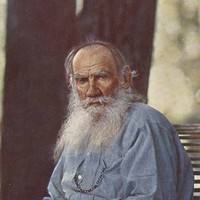
Leo Tolstoy (1828-1910) was a Russian author of novels, short stories, novellas, plays, and philosophical essays. He was born into an aristocratic family and served as an officer in the Russian military during the Crimean War before embarking on a career as a writer and activist. Tolstoy’s experience in war, combined with his interpretation of the teachings of Jesus, led him to devote his life and work to the cause of pacifism. In addition to such fictional works as War and Peace (1869), Anna Karenina (1877), and The Death of Ivan Ilyich (1886), Tolstoy wrote The Kingdom of God is Within You (1893), a philosophical treatise on nonviolent resistance which had a profound impact on Mahatma Gandhi and Martin Luther King Jr. He is regarded today not only as one of the greatest writers of all time, but as a gifted and passionate political figure and public intellectual whose work transcends Russian history and literature alike.
More by Leo Tolstoy




Why Readwise Books?
Readwise Books is an ebook & audiobook platform that automatically logs how much you and your friends read, making it fun and easy to read more. Learn more →