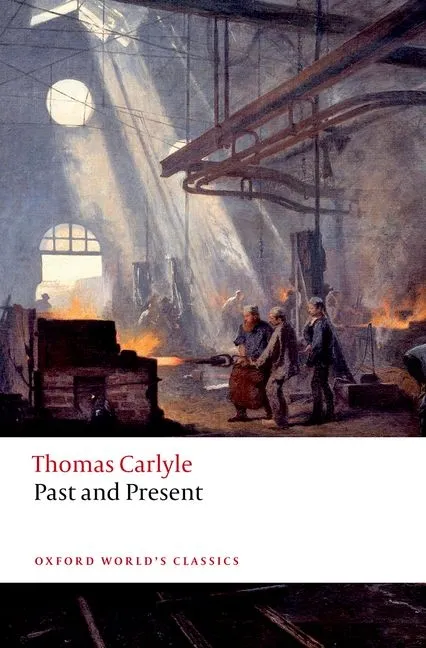
Past and Present
Report an issue
Tell us what's wrong and we'll take a look.
Thanks – we got it. We'll review and follow up if needed.
Past and Present also provided novelists and poets with an enduring vision of the ubiquitous rot that lay at the heart of 'laissez-faire' England. The repercussions of Carlyle's unique analysis can be witnessed in the literary form and thematic content of such works as Charles Dickens's Christmas Carol (1843), Dombey and Son (1848), Bleak House (1852-53), and Hard Times (1854); Benjamin Disraeli's Sybil (1845); Elizabeth Gaskell's Mary Barton (1848) and North and South (1855); and Charles Kingsley's Alton Locke (1850). Poets such as Alfred Tennyson in Maud (1855), Elizabeth Barrett Browning in Aurora Leigh (1856), and Arthur Hugh Clough in The Latest Decalogue (1862) built a vocabulary that was steeped in the outrage and indignation of Carlyle's polemic. The artist Ford Madox Brown attempted in his painting Work (1852-65) to give visual testimony to the profound social schisms that Carlyle had exposed in Past and Present and to pay tribute to the 'Sage' who had 'moulded a nation to his pattern.'
Thomas Carlyle
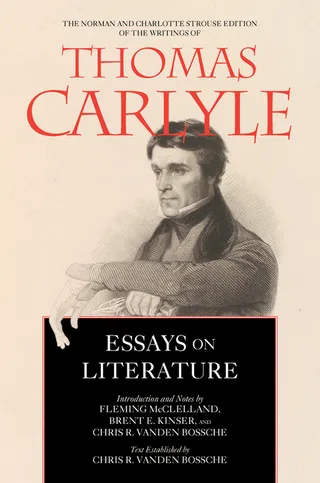
Thomas Carlyle was a British writer, historian, and philosopher who was born on December 4, 1795, and died on February 5, 1881. He was from the Scottish Lowlands. He was one of the most important writers of the Victorian age and had a big impact on art, literature, and philosophy in the 1800s. Born in Ecclefechan, Dumfriesshire, Scotland, Carlyle went to the University of Edinburgh and invented the Carlyle circle while there. When the arts course was over, he worked as a schoolmaster and studied to become a minister in the Burgher Church. He gave up on these and other things before he decided to write for the Edinburgh Encyclopaedia and work as a translator. Early on, he was successful by introducing little-known German literature to English readers through translations, his 1825 book Life of Friedrich Schiller, and review essays he wrote for a number of magazines. His first big book was called Sartor Resartus and came out between 1833 and 1834. After moving to London, his book The French Revolution (1837) made him famous, which led to the collection and reissue of his writings as Miscellanies.
More by Thomas Carlyle















Why Readwise Books?
Readwise Books is an ebook & audiobook platform that automatically logs how much you and your friends read, making it fun and easy to read more. Learn more →