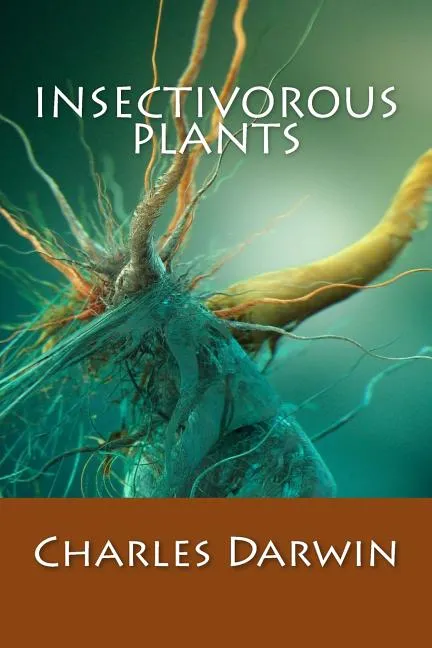
Insectivorous Plants
Report an issue
Tell us what's wrong and we'll take a look.
Thanks – we got it. We'll review and follow up if needed.
Insectivorous Plants is a book by British naturalist and evolutionary theory pioneer Charles Darwin, first published on 2 July 1875 in London. Part of a series of works by Darwin related to his theory of natural selection, the book is a study of carnivorous plants with specific attention paid to the adaptations that allow them to live in difficult conditions. It includes illustrations by Darwin himself, along with drawings by his sons George and Francis Darwin. The book chronicles Darwin's experiments with various carnivorous plants, in which he carefully studied their feeding mechanisms. Darwin tried several methods to stimulate the plants into activating their trap mechanisms, including feeding them meat and glass, blowing on them and prodding them with hair. He found that only the movement of an animal would cause the plants to react, and concluded that this was an evolutionary adaptation to conserve energy for prey and to ignore stimuli that were not likely to be nutritious. He also discovered that while some plants have distinct trap-like structures, others produce sticky fluids to ensnare their prey and concluded that this was an example of natural selection pressure resulting in various methods for food capture. The first edition had a reported printing of 3,000 copies. It was translated into several languages during Darwin's lifetime, including German. A second English-language edition was published in 1889 after Darwin's death. It was edited with additions and footnotes by Francis Darwin.
Charles Robert Darwin
Charles Robert Darwin (1809-1882) was a naturalist, geologist, and biologist hailing from Shropshire, England. He is most famous for his theory of evolution and natural selection, which posits that all species of life descend from a common ancestor and compete continuously for survival via genetic advantage. In 1831, Darwin joined the five-year voyage on the HMS Beagle to chart the coastline of South America. It was on this voyage that he penned his famous observations concerning the speciation of the tortoises, finches, and mockingbirds of the Galápagos Islands. That work would inform his later theories, which are still considered fundamental scientific concepts to this day.
More by Charles Robert Darwin




Why Readwise Books?
Readwise Books is an ebook & audiobook platform that automatically logs how much you and your friends read, making it fun and easy to read more. Learn more →