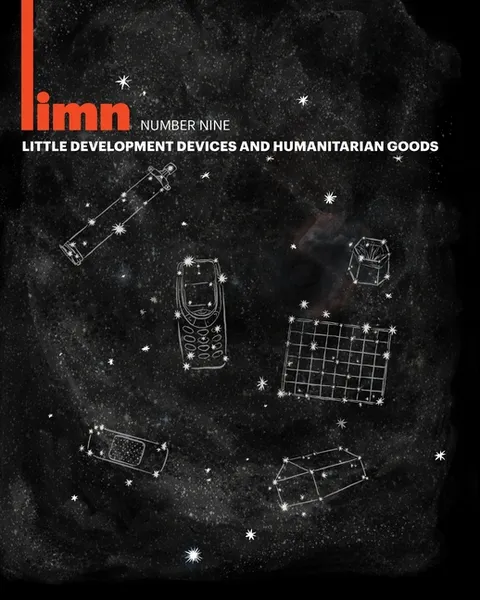
Limn Number 9
Little Development Devices/Humanitarian Goods
Report an issue
Tell us what's wrong and we'll take a look.
Thanks – we got it. We'll review and follow up if needed.
This issue of Limn examines the recent profusion of micro-technologies in the worlds of humanitarianism and development, some focused on fostering forms of social improvement, others claiming to alleviate suffering, and many seeking to accomplish both. From water meters, micro-insurance and cash transfers, to solar lanterns, water filtration systems, and sanitation devices, examples proliferate across the early 21st century landscapes of international aid. Although small-scale endeavors are far from novel, today these devices are animated by different intellectual and moral energy, drawing on novel financial and organizational resources. Many blur distinctions between public and private interests, along with divisions between obligations, gifts and commodities. At the same time, they entail novel configurations of expertise, political obligation and forms of care. The articles in this issue explore these new convergences of developmental and humanitarian projects, alongside reworked relationships between experts, governments, and purported beneficiaries, focused on fostering "participation" and "partnerships" rather than nation-building.
Peter Redfield
Peter Redfield is Professor of Anthropology at the University of North Carolina. He is the author of Space in the Tropics: From Convicts to Rockets in French Guiana.


Why Readwise Books?
Readwise Books is an ebook & audiobook platform that automatically logs how much you and your friends read, making it fun and easy to read more. Learn more →