Report an issue
Tell us what's wrong and we'll take a look.
Thanks – we got it. We'll review and follow up if needed.
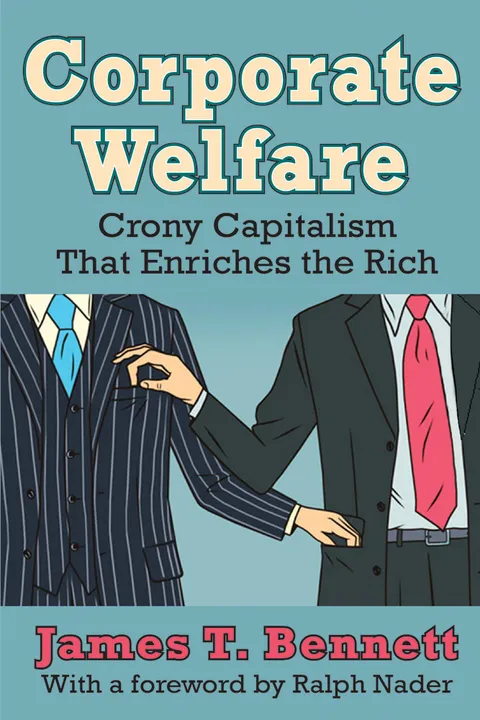
From the time of Alexander Hamilton’s “Report on Manufactures” through the Great Depression, American towns and cities sought to lure footloose companies by offering lavish benefits. These ranged from taxpayer-financed factories, to tax exemptions, to outright gifts of money. This kind of government aid, known as “corporate welfare,” is still around today. After establishing its historical foundations, James T. Bennett reveals four modern manifestations. His first case is the epochal debate over government subsidy of a supersonic transport aircraft. The second case has its origins in Southern factory relocation programs of the 1930s—the practice of state and local governments granting companies taxpayer financed incentives. The third is the taking of private property for the enrichment of business interests. The fourth—export subsidies—has its genesis in the New Deal but matured with the growth of the Export-Import Bank, which subsidizes international business exchanges of America’s largest corporate entities. Bennett examines the prospects for a successful anti-corporate welfare coalition of libertarians, free market conservatives, Greens, and populists. The potential for a coalition is out there, he argues. Whether a canny politician can assemble and maintain it long enough to mount a taxpayer counterattack upon corporate welfare is an intriguing question.
James T. Bennett
James T. Bennett (1942–2024) was a Research Fellow at the Independent Institute, Eminent Scholar, the William P. Snavely Chair of Political Economy and Public Policy in the Department of Economics, and Director of the John M. Olin Institute for Employment Practice and Policy at George Mason University. He received his Ph.D. in economics from Case Western Reserve University, and was a McKinsey Scholar at Columbia University, Ford Motor Company Scholar and Federal Reserve Bank of Cleveland Fellow; and specialized in research related to public policy issues, the economics of government and bureaucracy, labor unions, and health charities.
More by James T. Bennett





Why Readwise Books?
Readwise Books is an ebook & audiobook platform that automatically logs how much you and your friends read, making it fun and easy to read more. Learn more →