Report an issue
Tell us what's wrong and we'll take a look.
Thanks – we got it. We'll review and follow up if needed.
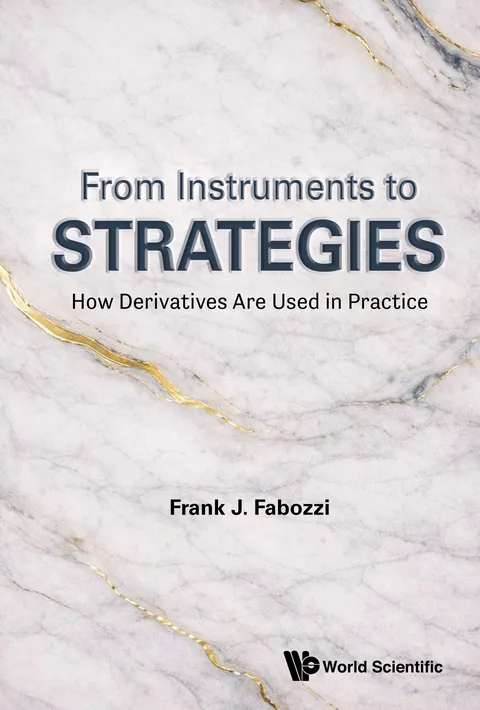
This book is an application-first, practice-grounded guide to derivatives. Its aim is to show how derivatives are used by asset management firms, corporations, and commercial and investment banks to solve real financial problems without turning the reader into a pricing specialist. It emphasizes application over abstraction while still covering valuation frameworks in their practical context.
The book adopts a modular structure that lets readers engage with derivatives from multiple entry points. Part 1 examines why organizations adopt derivatives, establishing the conceptual foundations that govern their use and misuse. Part 2 surveys the major derivative instruments and market structures, including forwards, futures, swaps, options, and structured and credit products. Part 3 turns to derivative strategies, covering speculative and hedging applications, portfolio integration, and backtesting, and reframes earlier concepts in terms of implementation and real-world applications. Part 4 examines institutional practice across corporate treasury, commercial banking, and investment banking, showing how identical instruments serve different purposes across balance sheets and client settings. Part 5 develops no-arbitrage valuation for forwards and futures, the probabilistic foundations of option pricing, discrete-time lattice methods, the Black–Scholes–Merton framework, and swap valuation, emphasizing assumptions, limitations, and market realities.
Pedagogically, From Instruments to Strategies builds intuition before formalism. Market structure essentials, such as clearing, daily mark-to-market, and margining for exchange-traded derivatives, are presented to link theory with trading mechanics. The objective is to demystify derivatives, not as villains or saviors, but as tools whose impact depends on how they are used.
Contents:
- Foundations:
- Introduction
- Adopting Derivatives in Practice: Decision Drivers for Managers and Treasurers
- Classifying Derivatives: Structures, Functions, and Markets
- Derivative Instruments and Market Structures:
- Risk-Sharing with Linear Derivatives: Forwards, Futures, and Plain Vanilla Swaps
- Insurance-Type Derivatives: Options, Caps, Floors, and Credit Default Swaps
- Exchange-Traded Derivatives
- Structure and Mechanics of Over-the-Counter Derivatives
- Structured and Exotic Derivatives
- Credit Derivatives
- Derivative Strategies and Portfolio Applications:
- Executing Derivatives Strategies: Margin Practices and Rolling Mechanics
- Foundations of Option Value: Understanding Options for Derivative Strategies
- Speculation with Derivatives: Concepts, Strategies, and Execution
- Managing Risk with Derivatives: Principles, Practices, and Applications
- Derivatives in Asset Allocation and Multi-Asset Portfolios
- Evaluating Derivative Strategies Through Backtesting: Principles and Practices
- Institutional and Corporate Applications of Derivatives:
- Derivatives in Corporate Treasury Management
- Derivatives in Commercial Banking
- Derivatives in Investment Banking
- Valuation Frameworks for Derivatives:
- Futures and Forwards: Core Valuation Principles
- Quantitative Foundations for Option Pricing
- The Lattice Option Pricing Model
- The Black–Scholes–Merton Option Pricing Framework
- Framework for Valuing Swaps
Readership: MBA and Master's in Finance courses in derivatives, risk management, investments, and financial markets. Asset/portfolio managers, analysts, traders, and risk managers, as well as any involved with hedge funds, portfolios, corporate treasuries, institutional investments, or banks. As well as CFA candidates (Levels I-II) and continuing-education learners seeking practical explanations of instruments, strategy, and cor
Frank J Fabozzi
Frank J. Fabozzi, Ph.D., CFA, CPA, is professor of practice at the Carey Business School at Johns Hopkins University. He is the editor of The Journal of Portfolio Management, co-editor of the The Journal of Financial Data Science, and associate editor of The Journal of Fixed Income. and serves on the board of directors of the BlackRock Fixed Income Funds and the BlackRock BCIA Funds Board. Recipient of the CFA Institute's 2007 C. Stewart Sheppard Award and 2015 James R. Vertin Award. In 2002, Frank was inducted into the Fixed Income Society's Hall of Fame.
Francesco A. Fabozzi is the managing editor of The Journal of Financial Data Science and the director of Data Science for the CFA Institute Research Foundation. He has worked as a research associate at NYU's Courant Institute in the Department of Mathematical Finance and is on the Curriculum Board of the Financial Data Professionals Institution. He has coauthored several books on asset management. He earned an undergraduate degree in economics from Princeton University, a master's degree in Financial Analytics from the Stevens Institute of Technology, where he is an ABD doctoral student in data science.
More by Frank J Fabozzi


Why Readwise Books?
Readwise Books is an ebook & audiobook platform that automatically logs how much you and your friends read, making it fun and easy to read more. Learn more →