Report an issue
Tell us what's wrong and we'll take a look.
Thanks – we got it. We'll review and follow up if needed.
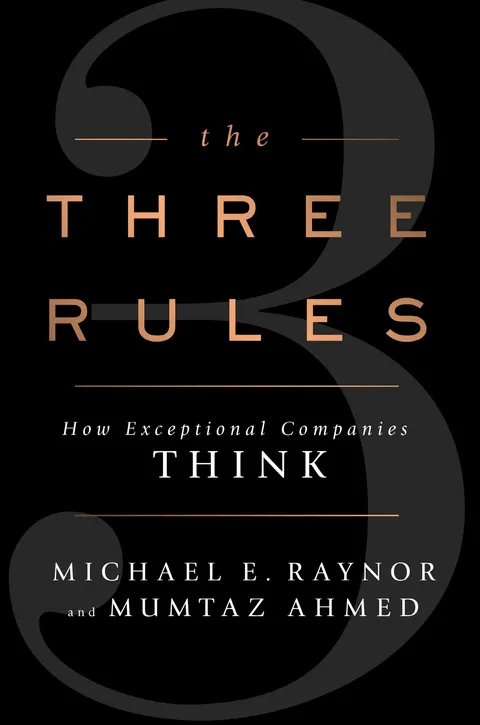
Finally, an answer to the ultimate business question: How do some companies achieve exceptional performance over the long term?
In every sector, there’s an outlier. In the pharmaceutical industry, it’s Merck. In discount retail, it’s Family Dollar. It used to be Wrigley in candy and Maytag in appliances. Other superstars have been hidden in plain sight, like Heartland Express in trucking or Linear Technology in semiconductors. How do these exceptional companies deliver superior performance over the long run despite facing the same constraints as competitors? What are they doing differently? What can we learn from them?
Michael E. Raynor and Mumtaz Ahmed have analyzed data on more than 25,000 companies spanning forty-five years. Their five-year study began with a sophisticated statistical analysis to identify which companies have truly exceptional performance, 344 in all.
In collaboration with teams of researchers, Raynor and Ahmed then put a carefully chosen representative sample of twenty-seven companies under the microscope to uncover what made the stand-out performers different. They found that exceptional companies, when faced with difficult decisions, follow three rules:
- Better before cheaper. They rarely compete on price.
- Revenue before cost. They drive profits through price and volume, not thrift.
- There are no other rules. Everything else is up for grabs, and they are willing to change anything to remain true to the first two rules.
The rules provide an indispensable compass that any company can use to chart its own path to greatness. Is it better to keep price down or invest in creating value that commands a higher price? Should you focus on talent and developing the abilities of your people or build processes to extend the capabilities of your organization? How about acquiring a sizable competitor to secure economies of scale—or a small start-up to gain access to new technology? According to Raynor and Ahmed, the right answers to these and just about every other question are the ones most closely aligned with the rules.
The Three Rules is built on a powerful combination of large-scale data analysis and in-depth case studies. Its guidance will increase the chance that your organization can become truly exceptional.
Michael E Raynor
Michael E. Raynor is a managing director at Deloitte. His twenty-five years of client work and practitioner-centered research address competitive and corporate strategy, innovation, and uncertainty. He is the author of The Strategy Paradox, The Innovator's Manifesto, and The Three Rules (with Mumtaz Ahmed). His current focus is applying these insights to the challenges of decarbonizing the global economy.
More by Michael E Raynor

Mumtaz Ahmed
Mumtaz Ahmed is a principal in Deloitte Consulting LLP and the chief strategy officer of Deloitte LLP, responsible for the US firm's strategy, corporate development, innovation, eminence, and brand.
More by Mumtaz Ahmed


Why Readwise Books?
Readwise Books is an ebook & audiobook platform that automatically logs how much you and your friends read, making it fun and easy to read more. Learn more →