Report an issue
Tell us what's wrong and we'll take a look.
Thanks – we got it. We'll review and follow up if needed.
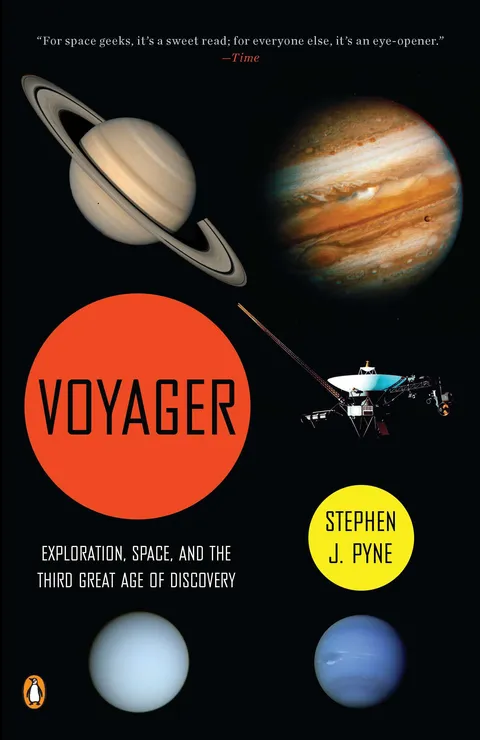
A brilliant new account of the Voyager space program-its history, scientific impact, and cultural legacy
Launched in 1977, the two unmanned Voyager spacecraft have completed their Grand Tour to the four outer planets, and they are now on course to become the first man-made objects to exit our solar system. To many, this remarkable achievement is the culmination of a golden age of American planetary exploration, begun in the wake of the 1957 Sputnik launch. More than this, Voyager may be one of the purest expressions of exploration in human history.
For more than five hundred years the West has been powered by the impulse to explore, to push into a wider world. In this highly original book, Stephen Pyne recasts Voyager in the tradition of Magellan, Columbus, Cook, Lewis and Clark, and other landmark explorers. The Renaissance and Enlightenment-the First and Second Ages of Discovery- sent humans across continents and oceans to find new worlds. In the Third Age, expeditions have penetrated the Antarctic ice, reached the floors of the oceans, and traveled to the planets by new means, most spectacularly via semi-autonomous robot. Voyager probes how the themes of motive and reward are stunningly parallel through all three ages. Voyager, which gave us the first breathtaking images of Jupiter and Saturn, changed our sense of our own place in the universe.
Stephen J. Pyne
Stephen J. Pyne is Professor Emeritus at Arizona State University and author of many books on the history and management of fire, including Fire: A Brief History and Between Two Fires: A Fire History of Contemporary America.
More by Stephen J. Pyne










Why Readwise Books?
Readwise Books is an ebook & audiobook platform that automatically logs how much you and your friends read, making it fun and easy to read more. Learn more →