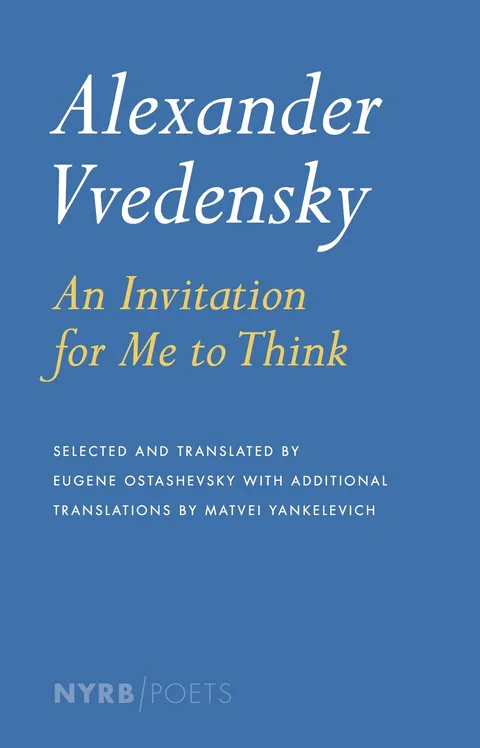
Alexander Vvedensky: An Invitation for Me to Think
Report an issue
Tell us what's wrong and we'll take a look.
Thanks – we got it. We'll review and follow up if needed.
“Pussy Riot are Vvedensky's disciples and his heirs.
Katya, Masha, and I are in jail but I don’t consider that we’ve been defeated.... According to the official report, Alexander Vvedensky died on December 20, 1941. We don’t know the cause, whether it was dysentery in the train after his arrest or a bullet from a guard. It was somewhere on the railway line between Voronezh and Kazan. His principle of ‘bad rhythm’ is our own. He wrote: ‘It happens that two rhythms will come into your head, a good one and a bad one and I choose the bad one. It will be the right one.’ ... It is believed that the OBERIU dissidents are dead, but they live on. They are persecuted but they do not die.”
— Pussy Riot [Nadezhda Tolokonnikova’s closing statement at their
trial in August 2012]
“I raise[d] my hand against concepts,” wrote Alexander Vvedensky, “I enacted a poetic critique of reason.” This weirdly and wonderfully philosophical poet was born in 1904, grew up in the midst of war and revolution, and reached his artistic maturity as Stalin was twisting the meaning of words in grotesque and lethal ways. Vvedensky—with Daniil Kharms the major figure in the short-lived underground avant-garde group OBERIU (a neologism for “the union for real art”)—responded with a poetry that explodes stable meaning into shimmering streams of provocation and invention. A Vvedensky poem is like a crazy party full of theater, film, magic tricks, jugglery, and feasting. Curious characters appear and disappear, euphoria keeps company with despair, outrageous assertions lead to epic shouting matches, and perhaps it all breaks off with one lonely person singing a song.
A Vvedensky poem doesn’t make a statement. It is an event. Vvedensky’s poetry was unpublishable during his lifetime—he made a living as a writer for children before dying under arrest in 1942—and he remains the least known of the great twentieth-century Russian poets. This is his first book to appear in English. The translations by Eugene Ostashevsky and Matvei Yankelevich, outstanding poets in their own right, are as astonishingly alert and alive as the originals.
Matvei Yankelevich
Translated by
Matvei Yankelevich is a poet, translator, and editor whose books include Some Worlds for Dr. Vogt (Black Square), Alpha Donut (United Artists), Boris by the Sea (Octopus), and, most recently, the chapbook From a Winter Notebook (Alder & Frankia). His translations from Russian include Today I Wrote Nothing: The Selected Writings of Daniil Kharms (Overlook) and, with Eugene Ostashevsky, Alexander Vvedensky’s An Invitation for Me to Think (NYRB Poets), which received the 2014 National Translation Award. He has been awarded fellowships from the National Endowment for the Arts, the New York Foundation for the Arts, and the National Endowment for Humanities. In the 1990s, he co-founded Ugly Duckling Presse where he edited, designed, and produced a variety of books, chapbooks, periodicals, and broadsides, co-edited 6×6 magazine, and curated the Eastern European Poets Series. He teaches translation and book arts at Columbia University’s School of the Arts.
Eugene Ostashevsky
Translated by
Eugene Ostashevsky is a poet, translator, and scholar. He is the author of The Pirate Who Does Not Know the Value of Pi and The Life and Opinions of DJ Spinoza. He teaches in the Liberal Studies program at NYU.






Why Readwise Books?
Readwise Books is an ebook & audiobook platform that automatically logs how much you and your friends read, making it fun and easy to read more. Learn more →