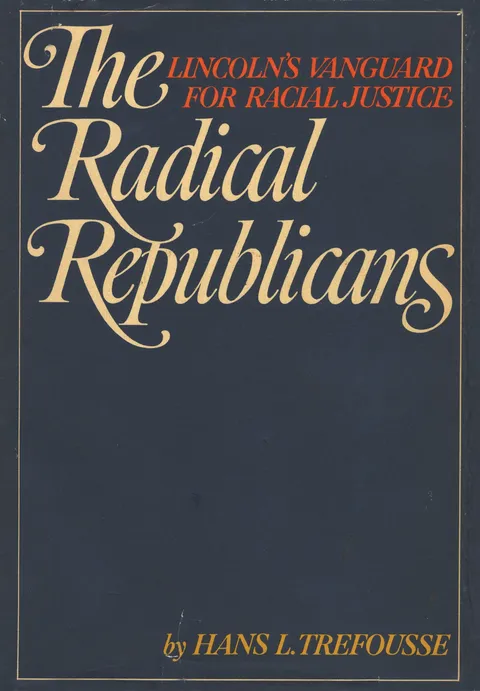
The Radical Republicans
Report an issue
Tell us what's wrong and we'll take a look.
Thanks – we got it. We'll review and follow up if needed.
This is the story of the men who, as political realists, fought for the cause of racial reform in America before, during, and after the Civil War. Charles Sumner, Thaddeus Stevens, Benjamin F. Wade, and Zachariah Chandler are the central figures in Mr. Trefousse's study of the Radical Republicans who steered a course between the extreme abolitionists on the one hand and the more cautious gradualists on the other, as they strove to break the slaveholder's domination of the federal government andthen to wrest from the postbellum South an acknowledgment of the civil rights of the Negro. The author delineates their key role in founding the Republican party and follows their struggle to keep the party firm in its opposition to the expansion of slavery, to commit it to emancipation, and finally to make it the party of racial justice.
This is the story as well of the tangled relationship of the Radical Republicans with Abraham Lincoln—a relationship of both quarrels and mutual support. The author stresses the similarity between Lincoln's ultimate aims and those of the Radical Republicans, demonstrating that without Lincoln's support Sumner and his colleagues could never have accomplished their ends—and that without their help Lincoln might not have succeeded in crushing the rebellion and putting an end to the slavery. And he argues that by 1865 Lincoln's Reconstruction policies were nearing those of the Radicals and that, had he lived, they would not have broken with him as they did with his successor.
Lincoln's assassination left the Radicals with no means to translate their demands into effective action. Their efforts to remake the South in such a way as to secure justice for the Negro brought them into conflict with President Johnson, in whose impeachment they played a leading role. Although they succeeded in initiating congressional Reconstruction and adding the fourteenth and fifteenth amendments to the Constitution, the Radicals lost power after the failure of the Johnson impeachment. Mr. Trefousse shows how, despite their declining influence throughout the 1870s, their accomplishments helped make possible—a century later—the resumption of the struggle for civil rights.
Hans L Trefousse
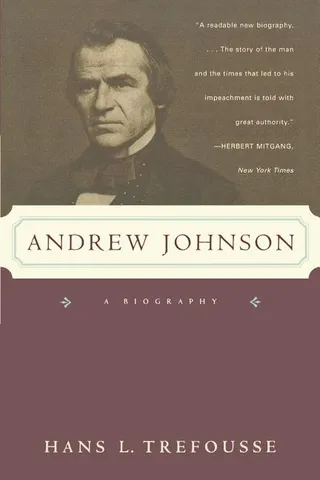
Hans L. Trefousse (1921-2010), whose many books include a biography of Andrew Johnson and a study of the radical Republicans, was Distinguished Professor of History at Brooklyn College and the Graduate Center of the City University of New York.
More by Hans L Trefousse











Why Readwise Books?
Readwise Books is an ebook & audiobook platform that automatically logs how much you and your friends read, making it fun and easy to read more. Learn more →