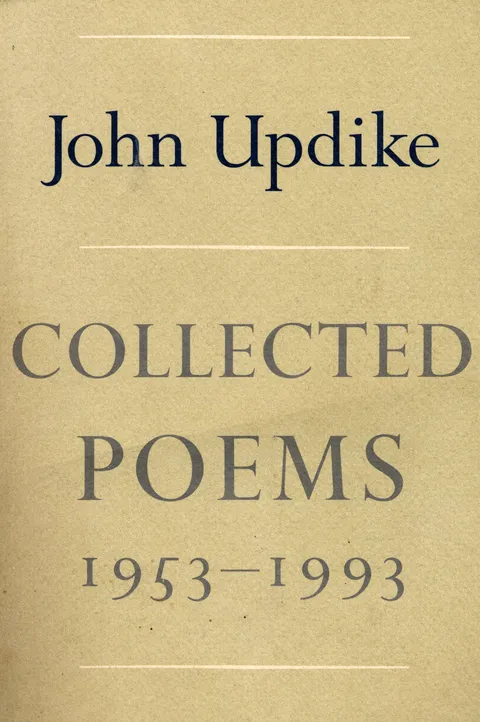
Collected Poems of John Updike, 1953-1993
Report an issue
Tell us what's wrong and we'll take a look.
Thanks – we got it. We'll review and follow up if needed.
“The idea of verse, of poetry, has always, during forty years spent working primarily in prose, stood at my elbow, as a standing invitation to the highest kind of verbal exercise—the most satisfying, the most archaic, the most elusive of critical control. In hotel rooms and airplanes, on beaches and Sundays, at junctures of personal happiness or its opposite, poetry has comforted me with its hope of permanence, its packaging of flux.”
Thus John Updike writes in introducing his Collected Poems. The earliest poems here date from 1953, when Updike was twenty-one, and the last were written after he turned sixty. Almost all of those published in his five previous collections are included, with some revisions. Arranged in chronological order, the poems constitute, as he says, “the thread backside of my life’s fading tapestry.” An ample set of notes at the back of the book discusses some of the hidden threads, and expatiates upon a number of fine points.
Nature—tenderly intricate, ruthlessly impervious—is a constant and ambiguous presence in these poems, along with the social observation one would expect in a novelist. No occasion is too modest or too daily to excite metaphysical wonder, or to provoke a lyrical ingenuity of language. Yet even the wittiest of the poems are rooted to the ground of experience and fact. “Seven Odes to Seven Natural Processes” attempt to explicate the physical world with a directness seldom attempted in poetry. Several longer poems—“Leaving Church Early,” “Midpoint”—use autobiography to proclaim the basic strangeness of existence.
John Updike
John Updike (1932-2009) was one of only three writers to win the Pulitzer Prize more than once (for Rabbit is Rich and Rabbit at Rest). He was a prolific writer who published more than twenty novels, over a dozen poetry collections, and essays, art and literary criticism, and children's books. His best known works include the Henry "Rabbit" Angstrom novels, the Henry Bech stories, and The Witches of Eastwick.
More by John Updike










Why Readwise Books?
Readwise Books is an ebook & audiobook platform that automatically logs how much you and your friends read, making it fun and easy to read more. Learn more →