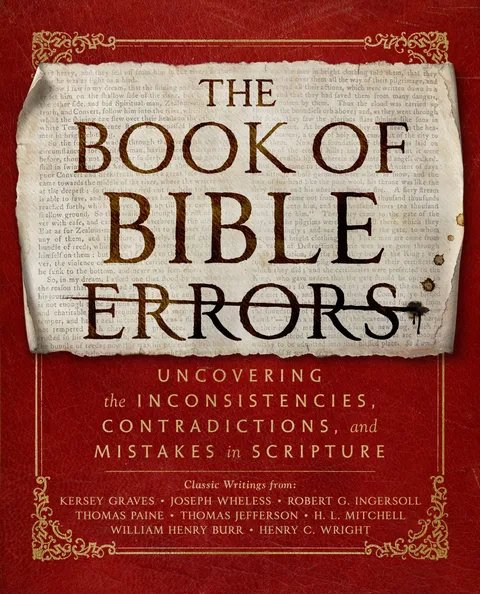
The Book of Bible Errors
Uncovering the Inconsistencies, Contradictions, and Mistakes in Scripture
Report an issue
Tell us what's wrong and we'll take a look.
Thanks – we got it. We'll review and follow up if needed.
An examination of biblical contradictions, for readers who value faith, reason, and honest inquiry.
The Book of Bible Errors brings together some of the most influential examinations of biblical inconsistencies ever written, offering readers a careful, historically grounded look at the tensions, contradictions, and unresolved problems within scripture. Rather than approaching the Bible as something to be defended at all costs or dismissed outright, this volume invites thoughtful engagement with the text as it stands—complex, layered, and human.
Featuring works by writers, theologians, journalists, and skeptics from the eighteenth through early twentieth centuries, the collection examines everything from conflicting genealogies and historical impossibilities to theological contradictions and narrative inconsistencies across the Old and New Testaments. Some contributors write as critics of religion, others as clergy attempting reconciliation, but together they document a long tradition of readers who believed that faith, if it is to mean anything, must withstand scrutiny.
Edited and introduced for a modern audience, The Book of Bible Errors is not a polemic but a resource: a reference work for readers who want to understand what the Bible says, where it disagrees with itself, and how these issues have been debated for centuries. It is a book for those who believe that honest questions do not weaken belief, but deepen it.
Kersey Graves
Graves was born in Brownsville, PA. His parents were Quakers, and as a young man, he followed in their footsteps, eventually shifting to the Hicksite branch of Quakerism. According to one source, Graves did not attend school for more than three or four months of his life, but another source claims that he had a "academical education" and began teaching at a Richmond school at the age of 19, a career he would continue for more than twenty years. He advocated for Abolitionism, was interested in language reform, and became linked with a number of radical freethinkers within Quakerism. In August 1844, he joined a group of roughly fifty utopian settlers from Wayne County, Indiana. Graves married Lydia Michiner, a Quaker, in July 1845 at Goschen Meeting House in Zanesfield, Logan County, Ohio, and the couple raised five children in Harveysburg, Ohio. They then returned to Richmond and purchased a farm. The Goschen Meeting House was a Congregational Friends center dedicated to Temperance and Peace, health reform, anti-slavery, women's rights, and socialistic utopianism. Graves' Quaker upbringing conditioned him to believe in the idea of the Inner Light, which held that all clergy, creeds, and prescribed liturgy in worship were irrelevant and impediments to God's mission. This was exacerbated by Hicks' version of Quakerism, Quietism, in which an individual's spiritual life was paramount and all outward manifestations were invalid.
More by Kersey Graves


Why Readwise Books?
Readwise Books is an ebook & audiobook platform that automatically logs how much you and your friends read, making it fun and easy to read more. Learn more →