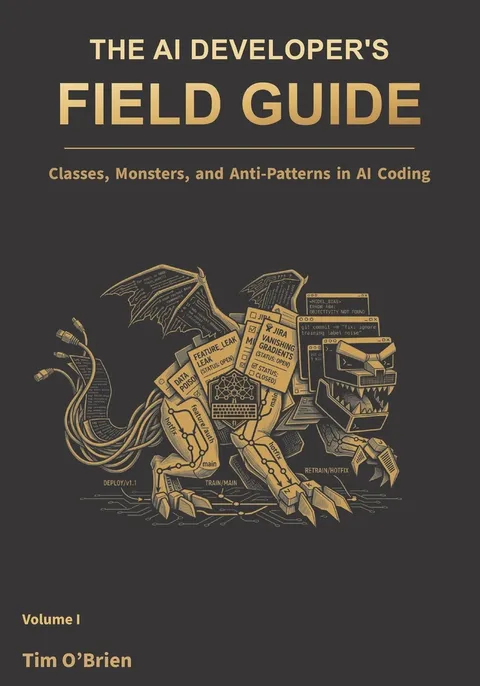
The AI Developer's Field Guide
Volume I: Classes, Monsters, and Anti-Patterns in AI Coding
Report an issue
Tell us what's wrong and we'll take a look.
Thanks – we got it. We'll review and follow up if needed.
Classes, Monsters, and Anti-Patterns in AI Coding
Generative AI has changed software development. It has also introduced a new class of failure.
Code can now look correct, pass tests, and still be wrong in ways that only show up later-in production, in edge cases, or in the hands of the next developer. This book is about those failures.
What This Book CoversThe most common AI coding anti-patterns in modern software teams
How tools like ChatGPT, GitHub Copilot, and Claude change code quality, review, and architecture
Why AI-generated code often produces plausible but incorrect results
How technical debt forms faster in AI-assisted development workflows
Practical techniques for code review, testing, and prompt discipline
A Practical Framework for AI-Assisted Development
This book introduces a working vocabulary for understanding how teams actually behave with AI:
Developer archetypes (Fighter, Wizard, Rogue, Cleric)
Failure modes (Scope Creep Kraken, Congealing Slop, Phantom Intern, and others)
Tool-driven patterns that emerge from real-world usage
These are not metaphors for their own sake. They are labels for repeatable problems teams encounter when using AI to write code.
Who This Is For
Software engineers using AI coding tools
Engineering managers and technical leads
Teams adopting AI-assisted software development
Anyone responsible for code quality, maintainability, and delivery
The Problem
AI makes it easy to generate code faster than you can understand it.
That creates predictable issues:
Systems that grow quickly but are difficult to maintain
Code that passes review but fails under real conditions
Teams that ship more while understanding less
Without shared language, these problems are hard to identify and harder to fix. This book provides that language.
What You Get
A clear way to diagnose problems in AI-generated code
Patterns you can reference in code reviews and retrospectives
Concrete practices that improve how teams use AI tools
A framework for staying effective as development continues to change
This book helps you avoid the most common mistakes-and build better habits before they become defaults.
Tim O'Brien
TIM O'BRIEN received the National Book Award for Going After Cacciato. The Things They Carried has sold more than seven million copies; it was a finalist for the Pulitzer Prize for Fiction and was named a New York Times Book of the Century. In the Lake of the Woods won the James Fenimore Cooper Prize. Awarded the Pritzker Literature Award for lifetime achievement in military writing, O'Brien has been elected to both the American Academy of Arts and Letters and the American Academy of Arts and Sciences.
More by Tim O'Brien









Why Readwise Books?
Readwise Books is an ebook & audiobook platform that automatically logs how much you and your friends read, making it fun and easy to read more. Learn more →