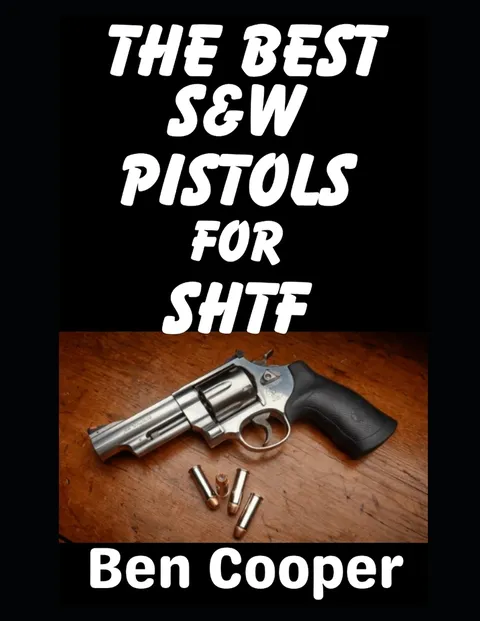
The Best Smith & Wesson Pistols For SHTF
These Are The Smith & Wesson Pistols and Revolvers That You Can Depend Your Life Upon
Report an issue
Tell us what's wrong and we'll take a look.
Thanks – we got it. We'll review and follow up if needed.
Ben Cooper spent years dismissing Smith & Wesson as a legacy brand coasting on reputation. His collection centered on SIG Sauer pistols, and he viewed Smith & Wesson revolvers as outdated relics and their semi-automatics as inferior to European alternatives. Then he met Marcus Webb, a retired FBI firearms instructor who carried a Smith & Wesson 5906 professionally for nine years and qualified Expert with it every single year of his Bureau career.
What followed was a nine-month education that systematically dismantled Cooper's assumptions and replaced them with documented reality. Through extensive shooting, honest evaluation, and Marcus's patient instruction, Cooper discovered that Smith & Wesson's 170 years of continuous manufacturing had produced firearms that solved problems newer alternatives hadn't addressed as effectively and in some cases hadn't even attempted to solve.
Cooper examines nine specific Smith & Wesson platforms, each selected for the specific role it fills in serious preparedness planning. The Model 60 is the pocket revolver that has provided concealed carry capability since 1965 disappearing completely in a pocket while delivering genuine defensive power through nearly sixty years of continuous production. The Model 65 is the proven K-frame service revolver that armed American law enforcement through some of the most dangerous decades in the nation's history, with Marcus's example showing 35,000 rounds and forty-six years of reliable service. The Model 29 is the legendary .44 Magnum that earned its reputation through actual hunting and wilderness use long before Hollywood made it famous.
The 3913 tells Cooper's most personal story in the book-the used 3913NL that arrived at his local gun store and connected with his hands and instincts so completely that he found himself crying in the parking lot. Despite being manufactured over thirty years ago, the pistol produced shooting performance that exceeded newer alternatives, becoming Cooper's daily carry despite every rational argument suggesting he should choose something more modern.
The 5906 represents the moment Smith & Wesson proved they could build a full-size semi-automatic competing with the best firearms available anywhere. The FBI adopted it after rigorous evaluation, and Marcus carried it professionally through situations where malfunctions meant death. The 4506 takes that proven platform and chambers it in .45 ACP...connecting over 110 years of American fighting tradition with modern semi-automatic engineering in a home defense pistol that honors the past while delivering contemporary capability.
The M&P covers both first and second generations; the pistol that transformed Smith & Wesson from a struggling legacy manufacturer into one of the most successful firearms companies in the world. The first generation proved they could compete with Glock. The second generation proved they could exceed it. The Shield closes the book by solving the everyday carry problem that the firearms industry had struggled with for decades, producing a pistol slim and light enough that millions of Americans carry it every single day without thinking about it.
Cooper doesn't pretend Smith & Wesson firearms are perfect for every application. He honestly addresses capacity limitations, parts availability concerns for discontinued models, and situations where newer alternatives offer genuine advantages.
This is not a collection of specification comparisons or range test results. It is an honest account of one shooter's education in what 170 years of firearms manufacturing actually delivers when evaluated objectively....written by someone who arrived skeptical and left convinced not by marketing, but by performance.
Ben Cooper
In 2003, looking to pursue a career in the space program, Ben Cooper attended Embry-Riddle Aeronautical University in Daytona Beach, FL, and earned a degree in aerospace engineering in 2008. During his time there, he photographed launches. By his graduation, he had a broad portfolio in photography and offers to apply for a NASA photographer position. He was privileged to photograph the remaining space shuttle launches and their mission preparations for NASA from 2008-2011, when the aging vehicles were retired. Much of this work was critical to the lives of the astronauts onboard, as NASA implemented broad documentation requirements for photography on the ground and in space during a mission following the Columbia accident in 2003. During the same period, new companies were being established and conducting their first launches in an era some have dubbed "New Space." Ben was quickly asked to capture the first flights of this new era.
More by Ben Cooper






Why Readwise Books?
Readwise Books is an ebook & audiobook platform that automatically logs how much you and your friends read, making it fun and easy to read more. Learn more →