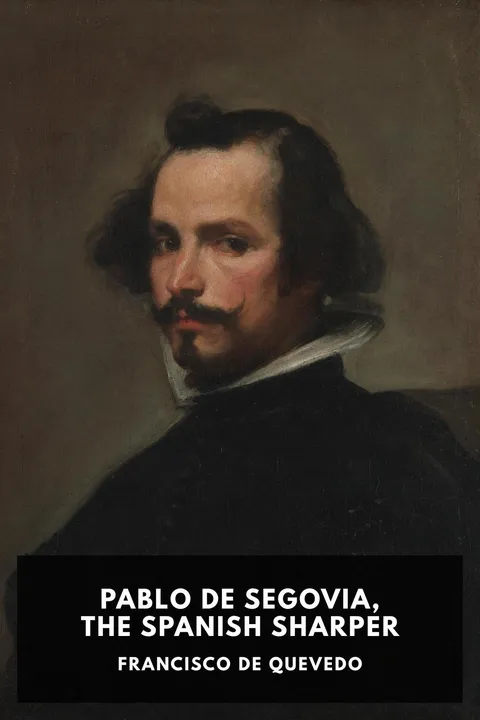
Pablo de Segovia, the Spanish Sharper
Report an issue
Tell us what's wrong and we'll take a look.
Thanks – we got it. We'll review and follow up if needed.
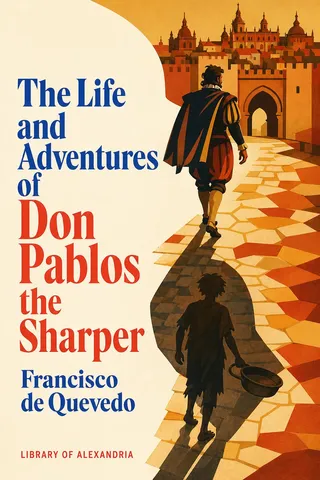
Francisco de Quevedo holds the status of a man-of-letters in the same pantheon as Cervantes; but despite that, Pablo de Segovia is his only novel. Quevedo had circulated the manuscript privately for several years before it was published in 1626 without his permission. The novel is partly a satire of contemporary Spanish life, and a caricature of the various social strata Pablo encounters and emulates.
Pablo himself is a low-born person who aspires to become a gentleman, but despite his best efforts he repeatedly fails and is eventually forced to become a "sharper," or rogue. His failures give Quevedo an avenue to expound on his belief that attempting to break past your social class can only lead to disorder; and that despite one's best efforts, bettering oneself is largely impossible. Pablo's stumbling from misfortune to misfortune is a farce that helped cement Quevedo's reputation as a literary giant.
Perfect for readers who love sharp social satire and roguish anti-heroes, this masterpiece from Spain's Golden Age delivers biting wit and unforgettable characters at every turn. Quevedo's brilliant portrayal of a cunning social climber navigating 17th-century Spanish society offers timeless insights into human ambition and class pretensions. A must-read classic that stands alongside Cervantes as one of Spain's greatest literary treasures.
The source for this public-domain ebook is Standard Ebooks (standardebooks.org). Ebooks from other sources often have typos, inconsistent spelling, missing accent marks, and missing punctuation. Ebooks from Standard Ebooks are proofread line by line against a scan of the original printed pages, then proofread again from cover to cover. They are also formatted and typeset following a professional-grade style manual, resulting in new editions supporting state-of-the-art ereader technology: automatic hyphenation, popup footnotes, complete and consistent metadata, high-resolution and scalable vector graphics, and ereader-compatible tables of contents. All of this makes the finished ebooks accurate, functional, and beautiful, a pleasure to read. (Waking Lion Press is not affiliated with or endorsed by Standard Ebooks.)
Francisco de Quevedo
Francisco Gómez de Quevedo (1580-1645) was a Spanish nobleman, politician, and writer, renowned as one of the leading figures of the Baroque literary movement. He was born on September 14, 1580, in Madrid to Francisco Gómez de Quevedo, who served as secretary to Maria of Spain, the daughter of Emperor Charles V, and María de Santibáñez, who was a lady-in-waiting to the queen. Quevedo came from a family of hidalgos (minor nobility) hailing from the village of Vejorís in Cantabria, part of the Castilian aristocracy. Quevedo is best remembered for his poetry, which was rooted in ""conceptismo,"" a style characterized by sharp wit, clarity, and brevity. This was in direct contrast to the more elaborate style of his rival, Luis de Góngora, who followed ""culteranismo,"" which favored more ornate and complex language. Along with Góngora, Quevedo was one of the most influential Spanish poets of his time. He is also known for his satirical works and his critique of society, which often highlighted the vices and moral contradictions of the age.
More by Francisco de Quevedo


Why Readwise Books?
Readwise Books is an ebook & audiobook platform that automatically logs how much you and your friends read, making it fun and easy to read more. Learn more →