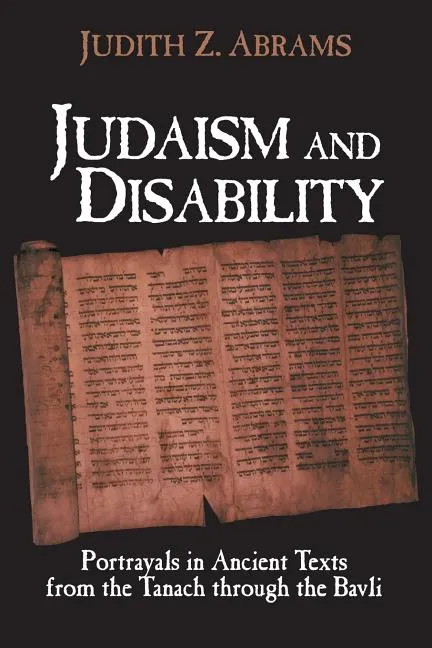
Judaism and Disability
Portrayals in Ancient Texts from the Tanach Through the Bavli
Report an issue
Tell us what's wrong and we'll take a look.
Thanks – we got it. We'll review and follow up if needed.
In Judaism and Disability, the archaic portrayals of mentally ill, mentally retarded, physically affected, deaf, blind, and other disabled people reflect the sharp contrast they presented compared to the unchanging Judaic ideal of the "perfect priest." All of these sources describe this perfection as embodied in a person who is male, free, unblemished, with da'at (cognition that can be communicated), preferably learned, and a priest. The failure to have da'at stigmatized disabled individuals, who were also compromised by the treatment they received from nondisabled people, who were directing and constraining.
As the Judaic ideal transformed from the bodily perfection of the priest in the cult to intellectual prowess in the Diaspora, a parallel change of attitudes toward disabled persons gradually occurred. The reduced emphasis upon physical perfection as a prerequisite for a relationship with God eventually enabled the enfranchisement of some disabled people and other minorities. Scholars, students, and other readers will find the engrossing process disclosed in Judaism and Disability one that they can apply to a variety of other disciplines.
Judith Z Abrams
Rabbi Judith Z. Abrams, PhD, an award-winning Jewish educator, is widely recognized for making the study of Judaism and its sacred texts accessible and relevant to our everyday lives. She is the founder and director of Maqom: A School for Adult Talmud Study (www.maqom.com) and a recipient of the Covenant Award for outstanding performance in the field of Jewish education. She teaches through the ALEPH rabbinic program and is author of Learn Talmud and Talmud for Beginners, among other books about Talmud and prayer. She is a popular speaker on the topics of Jewish learning and sacred literature.
More by Judith Z Abrams



Why Readwise Books?
Readwise Books is an ebook & audiobook platform that automatically logs how much you and your friends read, making it fun and easy to read more. Learn more →