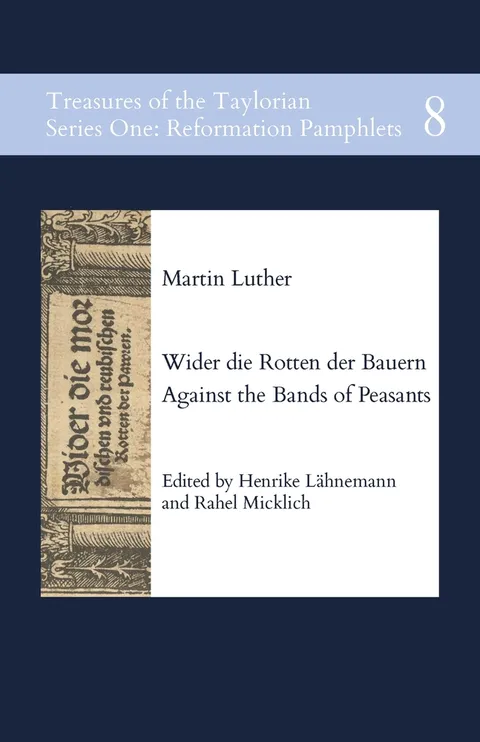
Wider die Rotten der Bauern. Against the Bands of Peasants
Report an issue
Tell us what's wrong and we'll take a look.
Thanks – we got it. We'll review and follow up if needed.
1525 was a dramatic year in German politics. The Peasants' War swept through South and East Germany and mobilised a large number of peasants in support of the movement, and an even larger number on the side of the princes and ruling classes opposing it. Martin Luther, dependent on the princes to realise his Reformation ideas, wrote one of the most vicious pamphlets of his life, attacking the ideas of the peasants, particularly their use of the term 'freedom'. He defended his own use of the term as pertaining only to spiritual freedom and condemned insurrection in the strongest terms, calling on the princes to "slay, choke and stab" any rebel.
500 years after its first publication, this edition with a new modern English translation, extensive linguistic and historical footnotes, and a comprehensive introduction contextualises the attack, both in terms of its historic significance and its afterlife. As in the previous volumes from the Reformation Series of the Taylor Editions, the text is based on pamphlets from the Taylorian collection which are also provided as facsimiles. The volume is published open access and with additional resources such as an audiobook and 'fold-your-own-pamphlet' for both of the copies held in the Taylorian. The introduction consists of eight chapters: in the first three, Rahel Micklich discusses in turn the historical background of the Peasants' War (1), the underlying conflict with radical reformer Thomas Müntzer (2), and the ensuing pamphlet war with the Catholic adversaries of Luther, particularly Johann Cochlaeus (3).
Timothy Powell then looks at the reception of the pamphlet in the GDR who were clearly taking the side of the peasants and of Thomas Müntzer against Luther's polemic (4). Marina Giraudeau and Tamara Klaric by contrast look at the contemporary reception of all of Luther's 1525 pamphlets on the topic as mirrored in the pamphlets held in the Taylorian and in the Bodleian Libraries in Oxford (5). The introduction is rounded off by a short explanation of the language of the pamphlet, the typographical conventions, and the principles guiding the edition by Henrike Lähnemann (6), with a comprehensive bibliography on the pamphlet (7).
Martin Luther
Martin Luther was a German professor of theology, as well as a composer, priest, monk, and seminal figure in the Protestant Reformation. Luther was ordained to the priesthood in 1507. He came to reject several teachings and practices of the Roman Catholic Church; in particular, he disputed its views on indulgences.
More by Martin Luther


Why Readwise Books?
Readwise Books is an ebook & audiobook platform that automatically logs how much you and your friends read, making it fun and easy to read more. Learn more →