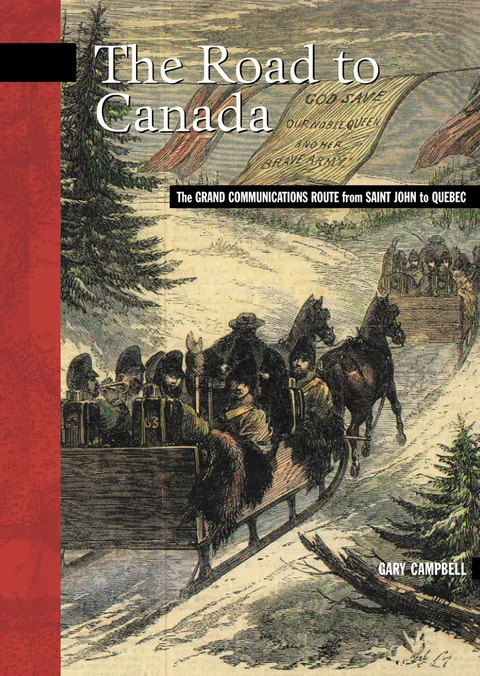
The Road to Canada
The Grand Communications Route from Saint John to Quebec Volume 5
Report an issue
Tell us what's wrong and we'll take a look.
Thanks – we got it. We'll review and follow up if needed.
Since the last Ice Age, the only safe route into Canada's interior during the winter started at the Bay of Fundy and followed the main rivers north to the St. Lawrence River through what is now New Brunswick. Aboriginal people used this route as a major highway in all seasons and the great imperial powers followed their lead.
The Grand Communications Route, as it was then called, was the only conduit for people, information and goods passing back and forth between the interior settlements and the wider world and became the backbone of empire for both England and France in their centuries of warfare over this territory. It was Joseph Robineau de Villebon, a commandant in Acadie, who first made strategic use of the route in time of war because he understood its importance in the struggle for North America. A strategic link between the Atlantic colonies and Quebec, the French made extensive use of the route to communicate and move troops between the northern settlements and Fort Beauséjour, Louisbourg, and Port-Royal. The British put great effort into maintaining and fortifying the route, building major coastal forts at Saint John to guard its entrance and erecting garrisons and blockhouses all along the way to the St Lawrence, first as a defence against the French and then to ward off the Americans.
The route also played a key role in the American Revolution as well as the Aroostook War of 1839 that saw bodies of troops lining each side of the border extending from St. Andrews (NB) and Calais (ME) to Madawaska. In 1842, the Grand Communications Route and the Webster-Ashburton Treaty determined the location of the Canada--US border.
It is still in use today: the Trans-Canada Highway and Route 7 follow its path. As well as telling the story of the Grand Communications Route from the earliest human habitation of the area, The Road to Canada describes the historic sites, forts, blockhouses and other historic remains that can still be visited today, including Martello Tower (Saint John), the Fort Hughes blockhouse (Oromocto), the Fort Fairfield blockhouse (Fort Fairfield, ME), Le Fortin du Petit-Sault (Edmundston), the Fort Kent blockhouse (Fort Kent, ME) and Fort Ingall (Cabano, QC).
The Road to Canada is volume 5 in the New Brunswick Military Heritage Series.
Campbell
Beth Anne Campbell is an award-winning author, corporate humorist, podcaster, and unapologetic truth-seeker who's spent almost as much time chasing spirits as she has chasing deadlines. Her debut book, Where the Hell Is My Bacon? won an International Impact Award in 2024 and cemented her reputation for blending humor, heart, and honesty in everything she writes.After publishing two nonfiction books about leadership and corporate life, Beth Anne decided it was time to channel her inner novelist. Her first novel, Case of the Demon Drums, won an International Impact Award in 2026. Case of the Mangled Man is the second book in The RIP Files trilogy and draws inspiration from her decade as a paranormal investigator. During those years, she discovered how much fear and psychology can affect hauntings. This inspired her to write about ghost hunting with realism, empathy, and a touch of dark humor.Beth Anne Campbell lives in Virginia with her husband, Sean, and their dog Moxie. She's a proud ally and firm believer that everyone deserves to live-and love-as their authentic self.
More by Campbell














Why Readwise Books?
Readwise Books is an ebook & audiobook platform that automatically logs how much you and your friends read, making it fun and easy to read more. Learn more →