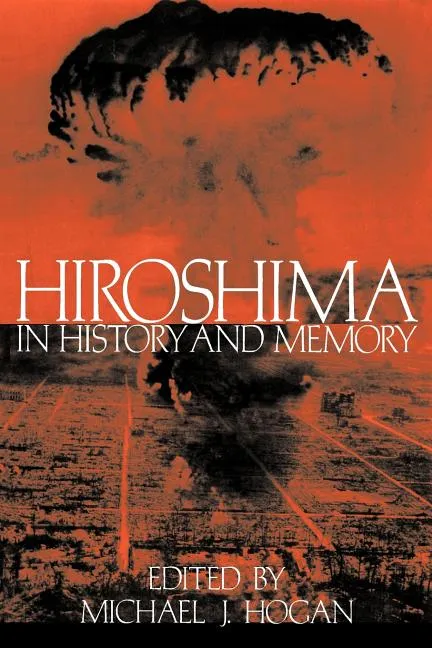
Hiroshima in History and Memory
Report an issue
Tell us what's wrong and we'll take a look.
Thanks – we got it. We'll review and follow up if needed.
In this timely collection of essays, prominent historians survey the Hiroshima story from the American decision to drop the first atomic bomb to the recent controversy over the Enola Gay exhibit in Washington, D.C. The first essay surveys the literature on the atomic bombing of Japan, while the second and third essays evaluate the decisions that led to that event. The remaining essays discuss how the Japanese and American people have remembered Hiroshima in the years since the end of World War II. They emphasize the construction of an official memory of Hiroshima, the challenge posed by alternative or counter-memories, and the tension between history and memory in the Hiroshima story. The collection thus unites up-to-date scholarship by diplomatic historians with the recent interest in memory that has emerged as part of the new cultural history.
Michael J Hogan
Michael J. Hogan is Distinguished Professor of History at the University of Illinois, Springfield. Hogan is the author of A Cross of Iron: Harry S. Truman and the Origins of the National Security State, 1945-1954 (2000); Informal Entente: The Private Structure of Cooperation in Anglo-American Economic Diplomacy, 1918-1928 (1977); and The Marshall Plan: America, Britain, and the Reconstruction of Western Europe, 1947-1952 (1987). He is co-editor of Explaining American Foreign Relations History, 2nd edition (with Thomas G. Paterson, Cambridge, 2003). Professor Hogan is a former president of the Society for Historians of American Foreign Relations, and served for fifteen years as editor of its journal, Diplomatic History.


Why Readwise Books?
Readwise Books is an ebook & audiobook platform that automatically logs how much you and your friends read, making it fun and easy to read more. Learn more →