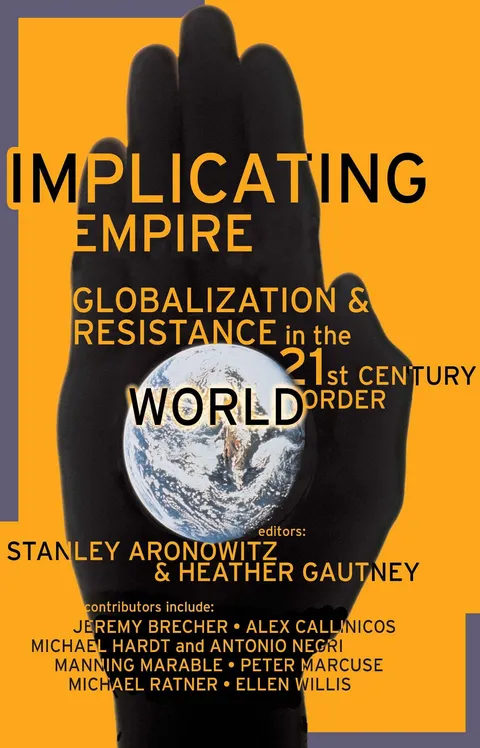
Implicating Empire
Report an issue
Tell us what's wrong and we'll take a look.
Thanks – we got it. We'll review and follow up if needed.
Over the past several years, while visible protests against the World Bank and the I.M.F. made front-page news, there has been a growing field of scholarship that looks at the role of globalization for national and international state identities. The first truism of globalization -- that we live in an increasingly interconnected world, one in which it is impossible to separate the fate of one nation from that of the others -- was dramatically illustrated on September 11, 2001, when the seemingly distant effects of a civil war in Afghanistan so murderously interrupted life in the United States. Implicating Empire is the first book to look at four crucial dimensions of globalization: first, its role vis-a-vis the current war; second, the impact of globalization on domestic U.S. policy; third, how globalization will necessarily alter national security, both in its definition as well as how it is pursued, and, finally, the future of globalization. Including original essays by Stanley Aronowitz, Ahmed Rashid, Tariq Ali, Manning Marable, Michael Hardt, and Ellen Willis, among others, Implicating Empire will set the agenda for how globalization is debated -- and resisted -- in the future.
Stanley Aronowitz
Stanley Aronowitz has taught at the Graduate Center of the City University of New York since 1983, where he is Distinguished Professor of Sociology and Urban Education, and where he is director of the Center for the Study of Culture, Technology and Work. He is author or editor of twenty-five books and is founding editor of the journal Social Text.


Why Readwise Books?
Readwise Books is an ebook & audiobook platform that automatically logs how much you and your friends read, making it fun and easy to read more. Learn more →