Report an issue
Tell us what's wrong and we'll take a look.
Thanks – we got it. We'll review and follow up if needed.
A Brookings Institution Press and American Enterprise Institute publication
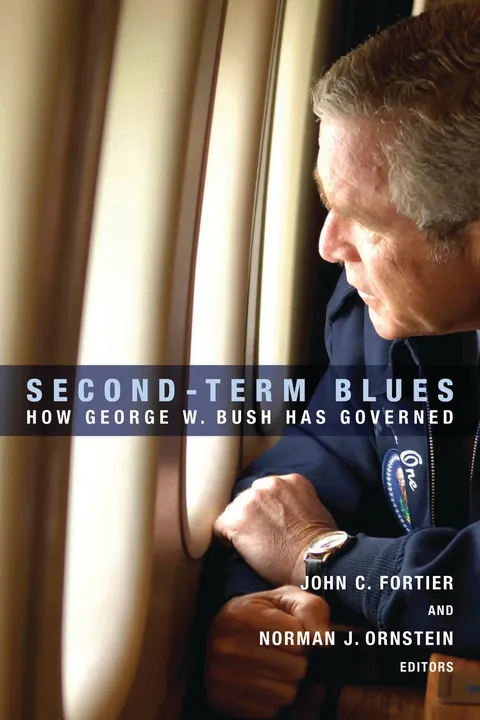
American presidents typically spend much of their first term trying to ensure a second term. Yet those ""four more years!"" are usually disappointing, replete with scandal, squabbling, plummeting approval, and few accomplishments. Thus far, George W. Bush's second term has largely followed that unfortunate pattern. In Second-Term Blues, John Fortier and Norman Ornstein lead a stellar cast of political analysts illuminating the priorities, governing tendencies, and leadership style of a president trying to steady his ship in rocky seas.
While the media obsess over who will be elected, they rarely ask how a candidate would govern if elected. For example, how would the president approach other political institutions? Would foreign policy stress caution and coordination, or will the U.S. ""go it alone""? What would be the tone of public persona and rhetoric? This is the first in-depth analysis of Bush's second go-round from that perspective.
The contributors include some of the shrewdest and best known observers of U.S. politics. David Sanger (New York Times) reveals how Bush's foreign policy, particularly on Iraq, defines and restricts his presidency. Dan Balz (Washington Post) dissects America's changing political mood and considers how the president's personal style fits into that milieu. Charles O. Jones, former president of the American Political Science Association, defines Bush's executive style: ""Seemingly, where narrow-margin politics appears to call for sensitive mastery of Congress, President Bush employs an unrelenting executive style, among the most intense ever."" In addition, Carla Robbins of the New York Times and Fred Greenstein of Princeton University make insightful contributions. This important book considers how all of this helps explain what we've seen coming out of Washington since 2001 and what it may portend for the future.
John C. Fortier
John C. Fortier is a senior fellow at the American Enterprise Institute, where he focuses on Congress and elections, election administration, election demographics, voting (and absentee voting), the US presidency, and the Electoral College. He is also continuing his work on the continuity of government. Before rejoining AEI, Dr. Fortier was director of governmental studies at the Bipartisan Policy Center, and the principal contributor to the AEI-Brookings Election Reform Project. He also has taught at Kenyon College, the University of Pennsylvania, the University of Delaware, Boston College, and Harvard University. He is the author and editor of “After the People Vote: A Guide to the Electoral College” (AEI Press, 2004; fourth edition, 2020); “Second-Term Blues: How George W. Bush Has Governed” (Brookings Institution Press, 2007); and “Absentee and Early Voting: Trends, Promises, and Perils” (AEI Press, 2006). A prolific writer, Dr. Fortier has been published in scholarly journals and the popular press, including Politico and The Hill. He is a frequent guest on radio and television, and he has appeared on ABC News, Bloomberg, BBC News, C-SPAN, CBS News, CNN, Fox News, NBC News’ “Today,” National Public Radio, and “PBS NewsHour,” among others. Dr. Fortier has a PhD in political science from Boston College and a BA in government from Georgetown University.
Norman J. Ornstein
Norman Ornstein is Resident Scholar the American Enterprise Institute and a contributing editor and columnist for National Journal and The Atlantic. He is the coauthor of the New York Times bestseller, It’s Even Worse Than It Looks.


Why Readwise Books?
Readwise Books is an ebook & audiobook platform that automatically logs how much you and your friends read, making it fun and easy to read more. Learn more →