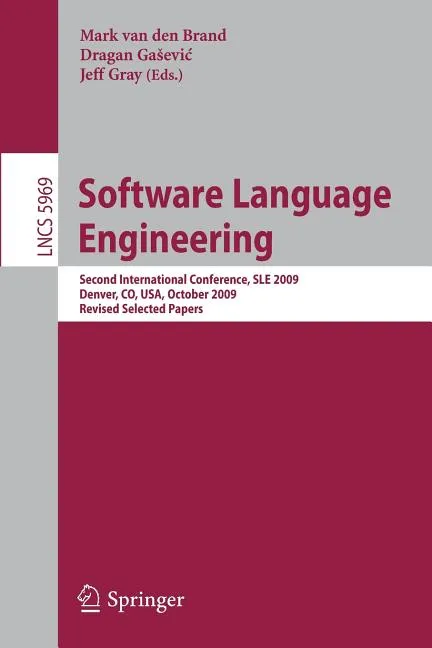
Software Language Engineering
Second International Conference, Sle 2009, Denver, Co, Usa, October 5-6, 2009 Revised Selected Papers
Report an issue
Tell us what's wrong and we'll take a look.
Thanks – we got it. We'll review and follow up if needed.
We are pleased to present the proceedings of the Second International Conf- ence on Software LanguageEngineering (SLE 2009). The conference was held in Denver, Colorado (USA) during October 5-6, 2009 and was co-located with the th 12 IEEE/ACM International Conference on Model-Driven Engineering L- th guages and Systems (MODELS 2009) and the 8 ACM International Conf- ence on Generative Programming and Component Engineering (GPCE 2009). TheSLEconferenceseriesisdevotedtoawiderangeoftopicsrelatedtoarti?cial languages in software engineering. SLE is an international research forum that brings together researchers and practitioners from both industry and academia to expand the frontiers of software language engineering. SLE'sforemostmissionis to encourageand organizecommunicationbetween communities that have traditionally looked at software languagesfrom di?erent, more specialized, and yet complementary perspectives. SLE emphasizes the f- damental notion of languages, as opposed to any realization in speci?c technical spaces. In this context, the term "software language" comprises all sorts of - ti?cial languages used in software development, including general-purpose p- gramming languages, domain-speci?c languages, modeling and meta-modeling languages, data models, and ontologies. Software language engineering is the application of a systematic, disciplined, quanti?able approach to the devel- ment, use, andmaintenanceoftheselanguages. TheSLEconferenceisconcerned with all phases of the lifecycle of software languages; these include the design, implementation, documentation, testing, deployment, evolution, recovery, and retirement of languages. Of special interest are tools, techniques, methods, and formalisms that support these activities. In particular, tools are often based on, or automatically generated from, a formal description of the language.
Mark Van Den Brand
Mark van den Brand is a Full Professor Software Engineering and Technology of the section Model Driven Software Engineering, Eindhoven University of Technology (TU/e). He got his PhD from the Radboud University (The Netherlands) in 1992. He worked as assistant professor at the University of Amsterdam after his PhD and moved in 1997 to CWI to work there as senior researcher for almost 10 years. In his Amsterdam period he worked on grammar based technologies to describe the syntax and semantics of programming languages. He was responsible for the redesign of the ASF+SDF Meta-Environment, a language workbench. Using ASF+SDF he worked on developing grammars and transformations for legacy languages. He also worked on the defining the syntax and semantics of domain specific languages. He published papers on both on the technologies developed for the ASF+SDF Meta-Environment as well as papers on applications of ASF+SDF. In this period he initiated the workshop series Language Descriptions, Tools and Applications (LDTA) that later on continued into the international conference on Software Language Engineering (SLE). He served for quite a number of years on the steering committee of SLE. Since 2006, he is a full professor of Software Engineering and Technology in the Department of Mathematics and Computer Science, and a visiting professor at Royal Holloway, University of London. His current research activities are on generic language technology, model driven engineering, domain specific models, meta-modeling, reverse engineering, and automotive software engineering. His research is industry inspired; he works with most of the high-tech companies in the Eindhoven (The Netherlands) region. He has been an invited lecturer and keynote speaker at various conferences, workshops and doctoral schools. He was and is member of PCs on workshops and conferences related to software engineering, language engineering, rewriting, reverse engineering, and software maintenance. He initiated the special issues of Science of Computer Programming devoted to academic software development (Experimental Software and Toolkits), and since 2007 has been guest editor of six of these. He is on the editorial board of the journals Science of Computer Programming and Open Computer Science. He is Editor-in-Chief of the Journal on Automotive Software Engineering. He is associate Editor-in-Chief of the Software Section of the Science of Computer Programming. He is associate Editor of the Journal of Object Technology.


Why Readwise Books?
Readwise Books is an ebook & audiobook platform that automatically logs how much you and your friends read, making it fun and easy to read more. Learn more →