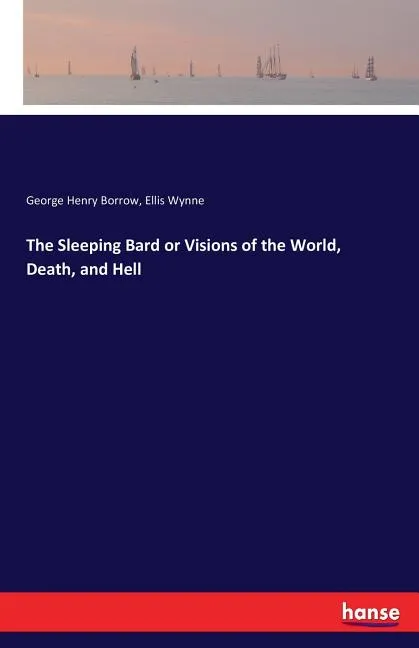
The Sleeping Bard or Visions of the World, Death, and Hell
Report an issue
Tell us what's wrong and we'll take a look.
Thanks – we got it. We'll review and follow up if needed.
The Sleeping Bard or Visions of the World, Death, and Hell is an unchanged, high-quality reprint of the original edition of 1860. Hansebooks is editor of the literature on different topic areas such as research and science, travel and expeditions, cooking and nutrition, medicine, and other genres. As a publisher we focus on the preservation of historical literature. Many works of historical writers and scientists are available today as antiques only. Hansebooks newly publishes these books and contributes to the preservation of literature which has become rare and historical knowledge for the future.
George Borrow
George Henry Borrow was an English novelist and travel writer who drew on his personal experiences in Europe. His travels gave him a close affinity for the Romani people of Europe, who play an important role in his work. His most well-known works are The Bible in Spain and the novels Lavengro and The Romany Rye, which are set during his stay among the English Romanichal (Gypsies). Borrow was born in East Dereham, Norfolk, the son of Thomas Borrow (1758-1824), an army recruiter, and Ann Perfrement (1772-1858), a farmer's daughter. His father, a lieutenant in the West Norfolk Militia, was imprisoned at Norman Cross from July 1811 to April 1813, and George spent his ninth and tenth years in the barracks there. He attended the Royal High School of Edinburgh and the Norwich Grammar School. Borrow studied law, but languages and literature became his primary passions. In 1825, he made his first major European excursion, trekking across France and Germany. Over the next five years, he traveled to Russia, Portugal, Spain, and Morocco, becoming acquainted with the people and languages of each country.
More by George Borrow




Ellis Wynne
Ellis Wynne (1671-1734) was a Welsh writer and cleric renowned for his contributions to early Welsh literature and religious thought. Born in Caernarfonshire, Wales, Wynne's work is primarily known for its allegorical and visionary themes, deeply rooted in Christian theology and moral philosophy. His most celebrated work, The Sleeping Bard: Or, Visions of the World, Death, and Hell, is a remarkable example of 18th-century Welsh allegory, offering a detailed exploration of morality, death, and the afterlife through a dream-like narrative. Wynne's writing is characterized by its satirical critique of contemporary society, religious practices, and human nature. His use of allegory serves to both entertain and educate, reflecting his commitment to moral and spiritual reflection. Despite being written in Welsh, Wynne's work had a significant impact on the Welsh literary tradition and provided valuable insights into the religious and cultural milieu of his time. His legacy endures as a pioneer in Welsh literature, influencing later writers and contributing to the rich tapestry of religious and philosophical discourse in early modern Wales.
More by Ellis Wynne


Why Readwise Books?
Readwise Books is an ebook & audiobook platform that automatically logs how much you and your friends read, making it fun and easy to read more. Learn more →