Doctor Therne
Report an issue
Tell us what's wrong and we'll take a look.
Thanks – we got it. We'll review and follow up if needed.
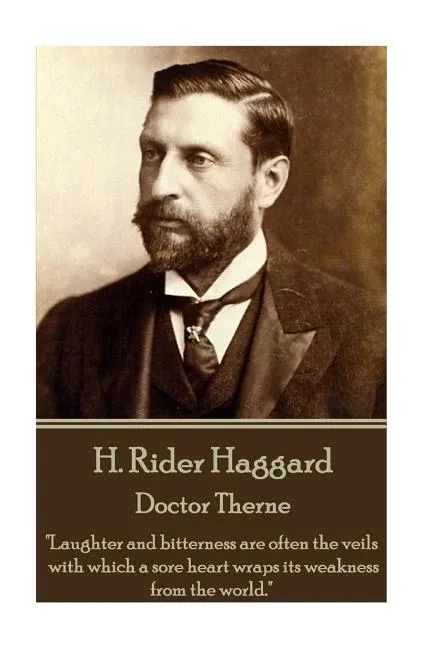
"Doctor Therne" is a novel by H. Rider Haggard. The story revolves around the life of James Therne, a physician in the city of Dunchester who becomes embroiled in controversy after advocating against compulsory smallpox vaccinations. A smallpox epidemic then breaks out in the city, killing thousands, and Therne is haunted by guilt for his role in the disaster. The novel explores themes of morality, guilt, and redemption, as well as the dangers of anti-vaccination movements. It also delves into the complexities of relationships, as Therne struggles to reconcile his love for his daughter with his guilt over her death. Overall, "Doctor Therne" is a thought-provoking novel that raises important questions about the responsibilities of those in positions of authority and the consequences of their actions.
H. Rider Haggard
Henry Rider Haggard was a prolific English writer whose works are full of action in colorful locations where his protagonists often find exotic, hidden societies and encounter numerous dangers and characters with strange powers. His best-known work is the romantic adventure tale King Solomon's Mines, which was inspired by Robert Louis Stevenson's Treasure Island. During his lifetime, Haggard wrote over forty books, many of which have been made into films, including the historical novel Cleopatra. Haggard was born in Norfolk, England, in 1856. He was the eighth son of a country squire and an amateur writer. Although his father considered him the family dunce, he was educated in private schools. In 1875, Haggard served as secretary to the governor of the Natal colony. He later joined the staff of the special commissioner and became master and registrar of the High Court in Transvaal. Like his friend Rudyard Kipling, Haggard was sympathetic to the British colonial policy but also saw the dangers of European intrusion. While in Africa, Haggard had an affair with an African woman and became fascinated with the Zulu culture. This inspired many novels, including his Zulu trilogy: Marie, Child of Storm, and Finished. Haggard returned to England, married a Norfolk heiress, and moved to his ostrich farm in Transvaal. However, when Transvaal was ceded to the Dutch, Haggard and his wife were forced back to England. Haggard studied law and was admitted to the bar, but he hardly practiced law. Instead, he devoted himself to writing. Between 1912 and 1917, he traveled extensively as a member of the Dominions Royal Commission. Haggard was an expert on agricultural and social conditions in England and on colonial migration. In 1912, he was knighted for his government services and was later appointed knight commander of the British Empire. Haggard died in London on May 14, 1925.
More by H. Rider Haggard


Why Readwise Books?
Readwise Books is an ebook & audiobook platform that automatically logs how much you and your friends read, making it fun and easy to read more. Learn more →