Report an issue
Tell us what's wrong and we'll take a look.
Thanks – we got it. We'll review and follow up if needed.
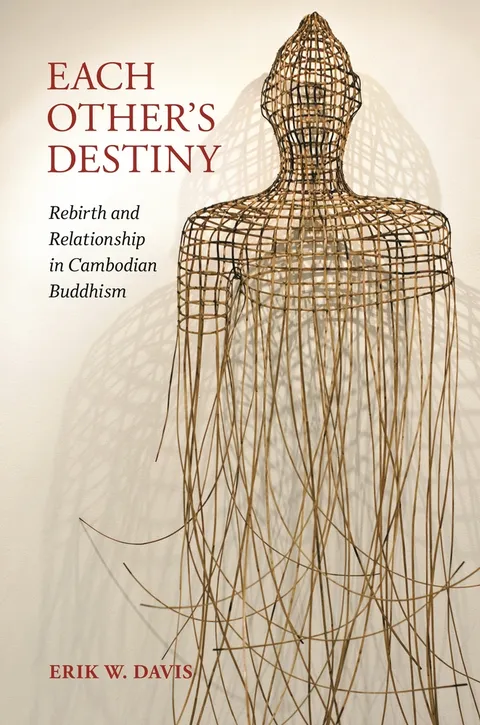
Each Other's Destiny presents stories of contemporary Cambodians who remember past lives and explores how memories of these pasts shape their present. Erik Davis examines accounts from children, adults, and elders who have retained past-life memories and reveals how Cambodians understand karma to work across lifetimes, and the central role of relationships in Buddhist moral progress. He suggests a new way of answering long-standing questions within Buddhism: what is reborn, and what does that mean we are?
The book focuses on six individuals Davis interviewed or researched extensively between 2003 and 2006. Two Cambodian women describe being kidnapped and taken to hell, revealing how near-death experiences are shaped by cultural imagination and expectations. Children who remember past lives provide insight into normative understandings of rebirth, and the karmic and ethical processes that underlie them. In one striking case, a young girl recalls being her own uncle, who died fighting for the Khmer Rouge in the 1970s. Davis describes the attempt to ritually force past-life amnesia on the child, revealing the importance of relatedness and karmic debts. He identifies a view of the individual and their rebirths that centers on karmically significant relationships, described as sharing a nissăy, a word frequently translated as "destiny" or "fate." This view, which appears normative in Cambodia, fundamentally shapes the way Cambodians think about relationships, family, maturation, and moral progress. Davis then turns to men who have deployed past-life memories for personal advantage, including former Cambodian Prime Minister Hun Sen, who claims identity with a past Khmer king, and a popular lay teacher professing to be Maitreya, the buddha of the future. These contrasting cases emphasize individual accomplishment and autonomy rather than relational obligations.
The final chapter follows a devout elder Buddhist woman who, as a child, integrated her past-life and present-life families. Her account exemplifies the relationality of past lives, karma, and destiny while affirming Buddhism's ultimate goal: to end rebirth and relationality entirely. Through these interconnected stories, Davis argues that it is karmic relationships--not individuals--that are reborn, suggesting that we are, in a meaningful way, each other's destiny.
Erik Davis
ERIK DAVIS is a scholar, journalist, and public speaker best known for his cultural analysis and creative explorations of esoteric mysticism. Davis has written about music, art, film, pop culture, and technology for Spin, Details, Rolling Stone, and Wired magazines. He is the author of Led Zeppelin IV (2005), The Visionary State: A Journey Through California's Spiritual Landscape (2006), and Nomad Codes: Adventures in Modern Esoterica (2010), and co-edited The Exegesis of Philip K. Dick (2011). Davis has appeared in a number of documentaries about technology and countercultural topics, including DMT: The Spirit Molecule, Electronic Awakening, and The Source. Along with Maja D'Aoust, he hosts a weekly podcast devoted to the "cultures of consciousness" called Expanding Mind, which is part of the Progressive Radio Network.
More by Erik Davis



Why Readwise Books?
Readwise Books is an ebook & audiobook platform that automatically logs how much you and your friends read, making it fun and easy to read more. Learn more →