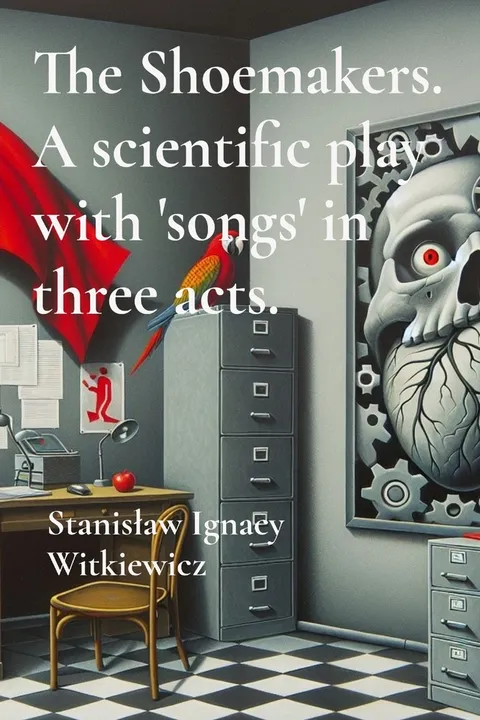
The Shoemakers. A scientific play with 'songs' in three acts.
Report an issue
Tell us what's wrong and we'll take a look.
Thanks – we got it. We'll review and follow up if needed.
by Stanislaw Ignacy Witkiewicz (Witkacy)
A wildly original political satire that feels startlingly modern.
Written in 1934, The Shoemakers is a bold, darkly comic stage play that explores revolution, power, class struggle, and the rise of technocracy. Set in a shoemakers' workshop that becomes the unlikely center of social upheaval, the play follows a series of rapid political transformations-each more extreme and absurd than the last.
As governments fall and new regimes take control, one question remains: does revolution truly change anything-or simply replace one system with another?
Blending satire, absurdist theatre, and sharp philosophical commentary, Witkacy creates a world where ideology turns theatrical, language becomes unstable, and human identity is caught in the machinery of history. The play's subtitle-"a scientific play with songs in three acts"-hints at its experimental form: part political farce, part intellectual drama, part grotesque comedy.
Readers and theatre lovers will discover:
- A biting critique of authoritarianism, revolution, and technocratic rule
- A groundbreaking work of 20th-century European drama
- A precursor to the Theatre of the Absurd
- Sharp political satire that still resonates today
- A daring mix of comedy, philosophy, and theatrical experimentation
Both unsettling and darkly hilarious, The Shoemakers challenges audiences to rethink power, ideology, and the future of society.
Perfect for readers interested in political drama, absurdist theatre, modernist literature, and avant-garde European plays, this classic work by Witkacy remains as provocative and relevant as ever.
If you are drawn to bold ideas, experimental theatre, and sharp social commentary, The Shoemakers is an essential addition to your library.Stanislaw Ignacy Witkiewicz
Stanislaw Ignacy Witkiewicz (1885-1939), known as Witkacy, was a playwright, novelist, painter, photographer and philosopher, and one of the most original figures of the European avant-garde. He was born in Warsaw on 24 February 1885, the son of the painter and critic Stanislaw Witkiewicz, creator of the Zakopane style. From 1890 the family lived in Zakopane, where the boy was educated at home according to his father's unorthodox principles and wrote his first plays as a child.He studied painting at the Kraków Academy of Fine Arts and travelled widely in Western Europe. In 1914, after the suicide of his fiancée, he joined the anthropologist Bronislaw Malinowski on an expedition that took him to Ceylon and Australia. When war broke out he went to St Petersburg, served as an officer in the Pavlovsk Regiment and witnessed the revolutions of 1917 at first hand.Back in Poland in 1918, he settled in Zakopane, exhibited with the Formists and set out his theory of Pure Form in New Forms in Painting (1919) and Theatre (1923). In the space of a few years he wrote more than two dozen plays, among them The Madman and the Nun and The Mother, though very few reached the stage in his lifetime; Cobblers, his last great play, followed in 1934. His novels Farewell to Autumn and Insatiability are dark visions of a civilisation sliding into mechanised uniformity, and his philosophy culminated in Concepts and Theorems Implied by the Concept of Being (1935). He earned his living through the tongue-in-cheek Portrait Company, whose pastels are now prized by museums and collectors alike.On 18 September 1939, the day after the Soviet army crossed Poland's eastern border, Witkacy took his own life in the village of Jeziory. Largely forgotten after the war, he was rediscovered during the political thaw of the 1950s. Today he is regarded as a forerunner of the Theatre of the Absurd, and his plays are staged around the world.
More by Stanislaw Ignacy Witkiewicz



Why Readwise Books?
Readwise Books is an ebook & audiobook platform that automatically logs how much you and your friends read, making it fun and easy to read more. Learn more →