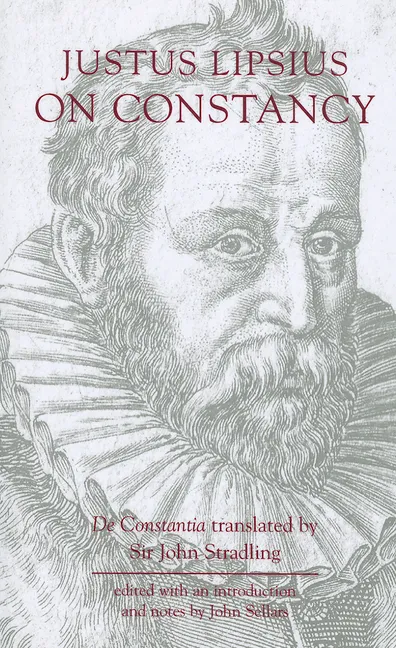
Justus Lipsius: On Constancy
Report an issue
Tell us what's wrong and we'll take a look.
Thanks – we got it. We'll review and follow up if needed.
Justus Lipsius' De Constantia (1584) is one of the most important and interesting of sixteenth century Humanist texts. A dialogue in two books, conceived as a philosophical consolation for those suffering through contemporary religious wars, De Constantia proved immensely popular in its day and formed the inspiration for what has become known as 'Neo-stoicism'. This movement advocated the revival of Stoic ethics in a form that would be palatable to a Christian audience. In De Constantia Lipsius deploys Stoic arguments concerning appropriate attitudes towards emotions and external events. He also makes clear which parts of stoic philosophy must be rejected, including its materialism and its determinism. De Constantia was translated into a number of vernacular languages soon after its original publication in Latin. Of the English translations that were made, that by Sir John Stradling (1595) became a classic; it was last reprinted in 1939. The present edition offers a lightly revised version of Stradling's translation, updated for modern readers, along with a new introduction, notes and bibliography.


Why Readwise Books?
Readwise Books is an ebook & audiobook platform that automatically logs how much you and your friends read, making it fun and easy to read more. Learn more →