Report an issue
Tell us what's wrong and we'll take a look.
Thanks – we got it. We'll review and follow up if needed.
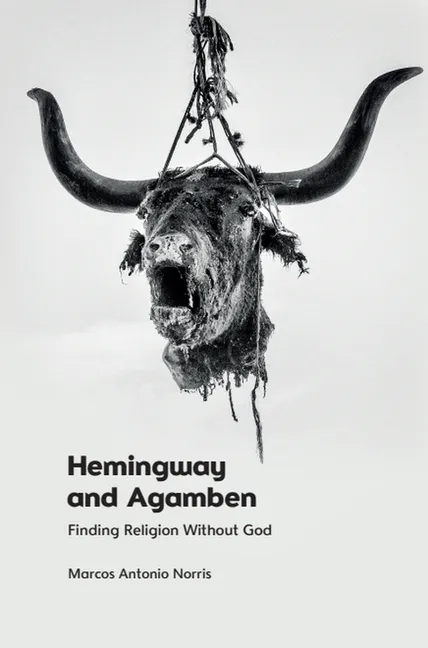
Marcos Antonio Norris implements Giorgio Agamben's notion of 'secularized theism' to resolve a critical disagreement among Hemingway scholars who have portrayed the writer as either a Roman Catholic or a secular existentialist. He argues that Hemingway is, properly speaking, neither a secularist nor a theist, but a 'secularised theist', whose 'religion' is practiced through sovereign decision making, which, in its most extreme form, includes the act of killing. This book resolves an important debate in Hemingway studies and uncovers fundamental similarities between theism and atheism, building upon the theoretical undertaking first introduced by Agamben and the Existentialists (EUP, 2021). Bringing Ernest Hemingway, Jean-Paul Sartre and Giorgio Agamben into close conversation, the author reconceptualises existentialism, issues a posthumanist critique of moral authoritarianism and advances an original interpretation of Hemingway as a secularised theist.
Marcos Antonio Norris
Marcos Antonio Norris is a lecturer in the School of Writing, Literature and Film at Oregon State University. He is the author of Hemingway and Agamben: Finding Religion Without God (2023) and the co-editor of Agamben and the Existentialists (2021). Norris has authored more than a dozen peer-reviewed articles, most recently including 'Reading 'On the Quai at Smyrna' and 'A Natural History of the Dead' in Consideration of Hemingway's Anti-Humanism' with The Hemingway Review and 'Francis Macomber, the Matador: Reading Hemingway's 'The Short Happy Life of Francis Macomber'' with Studies in the American Short Story.


Why Readwise Books?
Readwise Books is an ebook & audiobook platform that automatically logs how much you and your friends read, making it fun and easy to read more. Learn more →