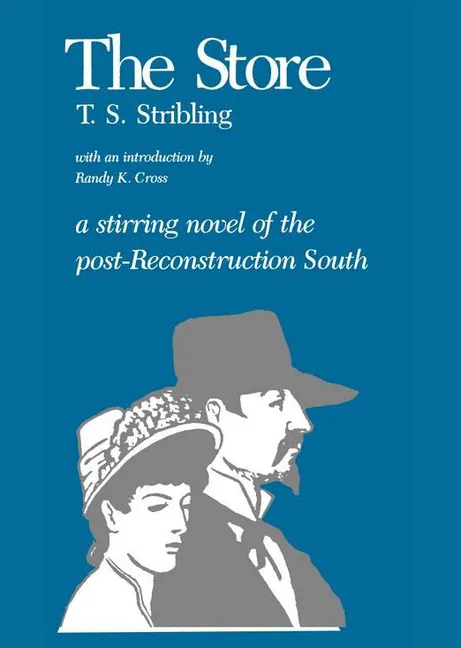
The Store
Report an issue
Tell us what's wrong and we'll take a look.
Thanks – we got it. We'll review and follow up if needed.
Pulitzer Prize for the Novel in 1933
The Pulitzer prize-winning The Store is the second novel of Stribling's monumental trilogy set in the author's native Tennessee Valley region of north Alabama. The action begins in 1884, the year in which Grover Cleveland became the first Democratic president since the end of the Civil War; and it centers about the emergence of a figure of wealth in the city of Florence.
In The Store, Stribling succeeds in presenting the essence of an age through the everyday lives of his characters. In the New Yorker, reviewer Robert M. Coates compared Stribling with Mark Twain in his ability to convey the "very life and movement" of a small Southern town: "Groups move chatting under the trees or stand loitering in the courthouse square, townsfolk gather at political 'speakings' and drift homeward separately afterward; always, in their doings, one has the sense of a whole community surrounding them, binding them together." Gerald Bullet wrote in The New Statesman and Nation that the novel "is a first-rate book...filled with diverse and vital characters; and much of it cannot be read without that primitive excitement, that eagerness to know what comes next, which is, after all, the triumph of the good story teller."
T S Stribling
T.S. Stribling (1881-1965) was an American writer and lawyer. Born in Tennessee, he was raised in a family of divided loyalties--his father, Christopher Columbus Stribling, fought for the Union Army, while his mother's family had sided with the Confederacy. In 1902, Stribling graduated from the Florence Normal School with a teaching certificate before moving to Tuscaloosa, Alabama to work as a teacher. In 1905, having abandoned his teaching career, he graduated with a law degree from the University of Alabama. Despite earning a good job, he left within two years after his use of office supplies to write fiction was discovered. He gained a reputation as an author of adventure stories for boys, detective fiction, and science fiction tales. In 1922, he published Birthright, a novel addressing themes of race and identity in the aftermath of Reconstruction. In 1930, he published The Forge, the first novel in his lauded Vaiden Trilogy. The Store (1932), the second novel in the series, was awarded the Pulitzer Prize, and remains Stribling's most enduring achievement. The Vaiden Trilogy, which concluded with Unfinished Cathedral (1934), is a sweeping historical study tracing three generations of the Vaiden family from Florence, Alabama. Although his novels were acclaimed by critics and such authors as William Faulkner, Stribling's reputation--once at the forefront of the Southern Literary Renaissance--has largely faded in the decades since his death and undoubtedly deserves reassessment.
More by T S Stribling


Why Readwise Books?
Readwise Books is an ebook & audiobook platform that automatically logs how much you and your friends read, making it fun and easy to read more. Learn more →