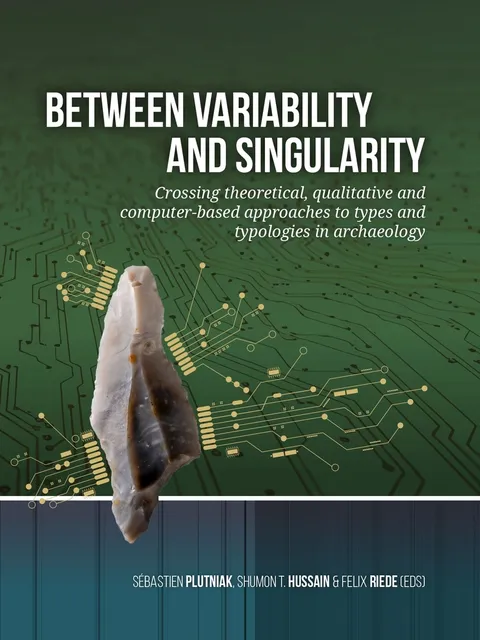
Between Variability and Singularity
Crossing Theoretical, Qualitative and Computer-Based Approaches to Types and Typologies in Archaeology
Report an issue
Tell us what's wrong and we'll take a look.
Thanks – we got it. We'll review and follow up if needed.
Typology remains a core archaeological classification practice, and this volume links theory, artifacts, and computation.
Typology is a core method and practice in archaeology. As a particular form of classification first developed during the infancy of the discipline itself, typology has remained an archaeological staple despite countless twists and turns. Rarely taught explicitly, and often critiqued, typology refuses to loosen its grip on archaeological practice.
In 14 chapters, this book explores how typology as a method and typologies as specific practices have developed, how typology is situated in contemporary theoretical thinking, and how typologies relate to the rapidly unfolding computational revolution that is reshaping the discipline. The volume offers state-of-the-art perspectives on typology grounded in all periods and across numerous artefact classes - ceramics, lithics, coins - as well as experimental articulations between typological thinking and mapping practices. Together, the chapters making up this volume challenge naïve typologizing and bring the topic of what we call things and how we classify them to the fore of archaeological debates. The volume is essential reading for graduate students and professionals alike; it offers critical perspectives on core principles of archaeological classification but also provides visionary signposts for how theory and computational methods engage with classification practices now and in the years to come.
Notably, this book is not only experimental in its content but also in its form: All chapters contained in it have been peer-assessed in their preprint forms such that earlier versions, all peer reviews and editorial recommendations are available as rich metadata. In this way, the volume sets new standards for bibliodiverse scholarly publishing at the interface between the digital and the physical.
Sébastien Plutniak
Sébastien Plutniak is a researcher at the French National Centre for Scientific Research (CNRS), working at the CITERES-LAT laboratory (Tours, France), and a former fellow of the École française de Rome. Trained as a prehistoric archaeologist and a sociologist and historian of science, his research focuses on contemporary and past uses of formal and computer-based methods in the humanities and social sciences -and archaeology in particular-, studied from practical, socio-historical, and epistemological perspectives.
As a field archaeologist he worked intensively in Borneo (2009-2016) and in New Guinea (2018-2024). Besides, he serves as a board member of the French Chapter of the "Computer Applications and Quantitative Methods in Archaeology" organisation, the "French Prehistoric Society", and the "History of Archaeology" commission of the "International Union for Prehistoric and Protohistoric Sciences".
Shumon T Hussain
Shumon T. Hussain is a transdisciplinary archaeologist with a research focus on Late Pleistocene and Early Holocene foragers, especially their stone artefact technologies and animal relationships. He is broadly interested in theoretical innovation and synthesis beyond archaeology as a disciplinary specialism, to better integrate data and perspectives across the humanities and sciences vis-à-vis question of the human deep past, and the epistemology and practice of science. He is currently based at the University of Cologne, Germany, where he is a senior researcher and lecturer at the newly established research hub MESH - Multidisciplinary Environmental Studies in the Humanities.
Felix Riede
Felix Riede is professor of archaeology at Aarhus University in Denmark. He holds a PhD from the University of Cambridge and has been visiting scholar at Harvard University's Department of Anthropology, the Department of Geography in Cambridge, and the Oeschger Center for Climate Change Research at Bern University.
Felix works within an extended evolutionary synthesis framework to understand human biocultural evolution, its cognitive, social, climatic and environmental correlates, causes, and consequences. Felix is an astute interdisciplinarian and his work integrates across scales from individual artefacts to global patterns, across methods from qualitative to quantitative, from the laboratory to the field, from the archive to abstract models, and across scientific fields. In addition to many scientific and popular journal articles and book chapters,
Felix is the author of "Splendid isolation. The eruption of the Laacher See volcano and southern Scandinavian Late Glacial hunter-gatherers" (AUP, 2017) and co-editor, with Payson Sheets, of "Going Forward by Looking Back: Archaeological Perspectives on Socio-Ecological Crisis, Response, and Collapse" (Berhahn, 2020).


Why Readwise Books?
Readwise Books is an ebook & audiobook platform that automatically logs how much you and your friends read, making it fun and easy to read more. Learn more →