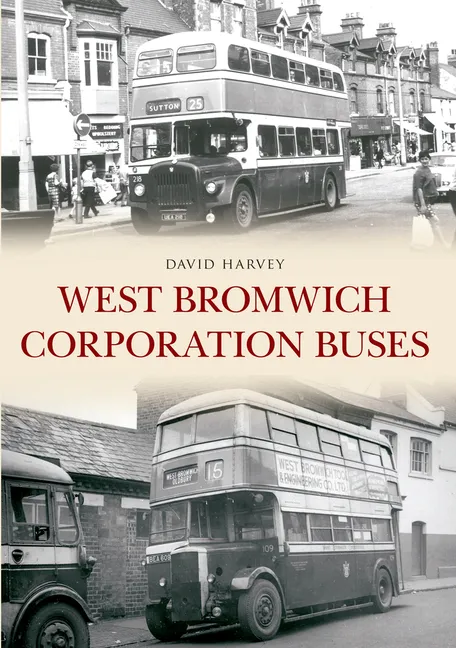
West Bromwich Corporation Buses
Report an issue
Tell us what's wrong and we'll take a look.
Thanks – we got it. We'll review and follow up if needed.
The West Bromwich Corporation Act of 1913 gave the Corporation the powers to operate motor buses, the first of which were four Albion single-deckers that lasted for less than seven weeks before the chassis were commandeered for war work in October 1914. After the First World War, bus services began to expand across Britain and West Bromwich was no exception; by the early 1930s there were routes to Great Bridge, Stone Cross, Hamstead, Streetly, Tantany, Black Lake, Hill Top, Greets Green and Smethwick and the Corporationʼs first joint route, to Walsall, had also been developed. The West Bromwich fleet was largely made up of single-deck vehicles until the mid-1930s, and after the Corporationʼs tramways were replaced on 1 January 1939, the Daimler COG6 became the standard double-decker, replaced during the Second World War by the Daimler CWA6 and nineteen Austerity buses. After the war, Daimler CVG6s and CVG6/30s became the vehicle of choice, in a beautiful blue livery that lit up West Bromwich. In this book, David Harvey looks at the West Bromwich Corporation bus fleet from 1914 to its last purchases of Daimler Fleetlines in 1969 just prior to being swallowed up by West Midlands PTE.
David Harvey
David Harvey teaches at the Graduate Center of the City University of New York and is the author of many books, including Social Justice and the City, The Condition of Postmodernity, The Limits to Capital, A Brief History of Neoliberalism, Spaces of Global Capitalism, and A Companion to Marx's Capital. His website is http://davidharvey.org
More by David Harvey








Why Readwise Books?
Readwise Books is an ebook & audiobook platform that automatically logs how much you and your friends read, making it fun and easy to read more. Learn more →