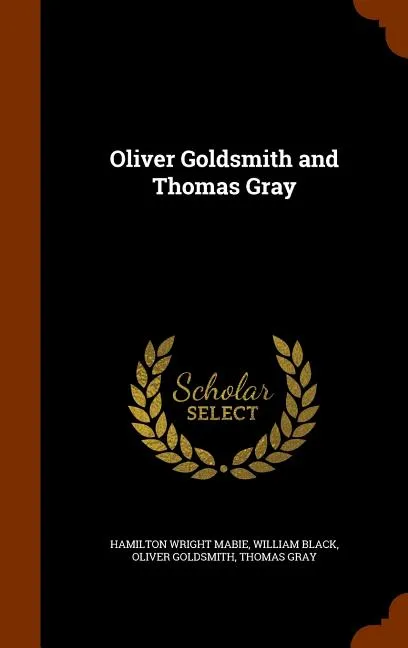
Oliver Goldsmith and Thomas Gray
Report an issue
Tell us what's wrong and we'll take a look.
Thanks – we got it. We'll review and follow up if needed.
This work has been selected by scholars as being culturally important, and is part of the knowledge base of civilization as we know it. This work was reproduced from the original artifact, and remains as true to the original work as possible. Therefore, you will see the original copyright references, library stamps (as most of these works have been housed in our most important libraries around the world), and other notations in the work.
This work is in the public domain in the United States of America, and possibly other nations. Within the United States, you may freely copy and distribute this work, as no entity (individual or corporate) has a copyright on the body of the work.
As a reproduction of a historical artifact, this work may contain missing or blurred pages, poor pictures, errant marks, etc. Scholars believe, and we concur, that this work is important enough to be preserved, reproduced, and made generally available to the public. We appreciate your support of the preservation process, and thank you for being an important part of keeping this knowledge alive and relevant.
Hamilton Wright Mabie
American essayist, editor, and critic Hamilton Wright Mabie (1846-1916) was born in Cold Spring, New York, on December 13, 1846. Known for his contributions to journalism, children's literature, and literature, he rose to prominence as a literary force in the late 19th and early 20th centuries. Mabie started out in journalism, employed by the New York Evening Post. Afterwards, he became an associate editor on the editorial board of the weekly journal Christian Union. As an editor, he had the ability to shape American readers' tastes in literature. In addition to his work as an editor and critic, Mabie promoted children's literature. He edited and put together a number of anthologies with the goal of introducing young readers to classic tales and folktales from throughout the globe, such as "Myths That Every Child Should Know" (1905) and "Folk Tales Every Child Should Know" (1905). He was a literary critic, essayist, and supporter of the usefulness of literature in forming young people's imaginations and cultural values.
More by Hamilton Wright Mabie

William Black
William Black was a novelist born in Glasgow, Scotland. During his lifetime, Black's works were extremely popular and compared favorably to those of Anthony Trollope. However, his renown and popularity did not last long into the twentieth century. William was born to James Black and his second wife, Caroline Conning. He was educated as a landscape painter, which affected his literary career. As a writer, he was recognized for his rich, atmospheric depictions of landscapes and seascapes in works like White Wings: A Yachting Romance (1880). He moved to London at the age of 23, after gaining some journalism experience in Glasgow. He began working for the Morning Star, then the Daily News, where he rose to the position of assistant editor. He wrote a weekly serial for The Graphic. During the Austria-Prussian War, he worked as a war correspondent. Black's debut novel, James Merle, was published in 1864 and had little popularity. Black then denied it and allegedly purchased copies to destroy them.
More by William Black







Why Readwise Books?
Readwise Books is an ebook & audiobook platform that automatically logs how much you and your friends read, making it fun and easy to read more. Learn more →