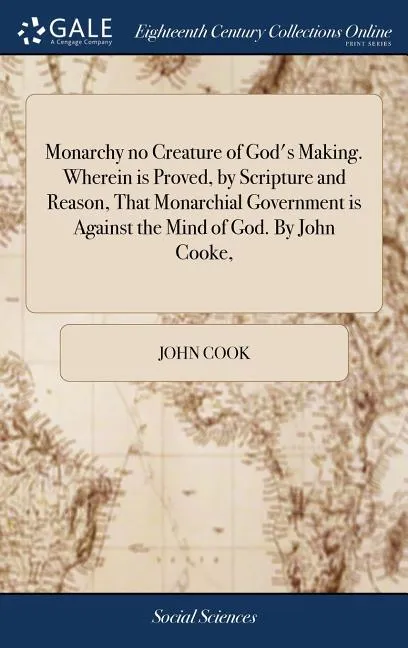
Monarchy no Creature of God's Making. Wherein is Proved, by Scripture and Reason, That Monarchial Government is Against the Mind of God. By John Cooke,
Report an issue
Tell us what's wrong and we'll take a look.
Thanks – we got it. We'll review and follow up if needed.
The 18th century was a wealth of knowledge, exploration and rapidly growing technology and expanding record-keeping made possible by advances in the printing press. In its determination to preserve the century of revolution, Gale initiated a revolution of its own: digitization of epic proportions to preserve these invaluable works in the largest archive of its kind. Now for the first time these high-quality digital copies of original 18th century manuscripts are available in print, making them highly accessible to libraries, undergraduate students, and independent scholars.
Delve into what it was like to live during the eighteenth century by reading the first-hand accounts of everyday people, including city dwellers and farmers, businessmen and bankers, artisans and merchants, artists and their patrons, politicians and their constituents. Original texts make the American, French, and Industrial revolutions vividly contemporary.
++++
The below data was compiled from various identification fields in the bibliographic record of this title. This data is provided as an additional tool in helping to insure edition identification:
++++
British Library
T135247
First published in 1651. The final 4p. sequence contains 'The editor's addendum' which is signed and dated: The editor (i.e. Daniel Isaac Eaton). September 26, 1794.
London: printed for D. I. Eaton, 1794. [2],112,4p.; 12°
John Cook
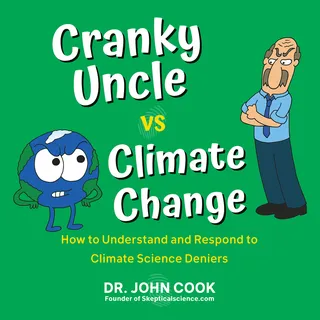
John Cook completed an honors degree in physics at the University of Queensland, Australia. While completing his degree, he often drew cartoons in the margins of his physics notes. After graduating, he spent a decade as a cartoonist and graphic designer. However, he never strayed far from science and spent his spare time reading climate research and debunking misinformation.
In 2007, Cook founded SkepticalScience.com. He began exploring how to combat science denial and completed a PhD on the cognitive psychology of misinformation. He found that inoculation, or explaining techniques of denial, was the key to neutralizing misinformation, and that parallel argumentation was a powerful way to put it into practice. This inspired him to bring together his two careers, using parallel arguments in the form of cartoons to explain the techniques of science denial.
Cook is currently a research assistant professor with the Center for Climate Change Communication at George Mason University, where he focuses on combatting fake news by using critical thinking to inoculate against misinformation.
More by John Cook




Why Readwise Books?
Readwise Books is an ebook & audiobook platform that automatically logs how much you and your friends read, making it fun and easy to read more. Learn more →